
NEWS
NLC Steps Down Telecom Tariff Hike Protest On FG’s Intervention


Sequel to the intervention of the Federal Government of Nigeria (FGN) the Nigeria Labour Congress (NLC) has suspended its planned nationwide protest against the recent 50 percent hike in telecom tariffs.
It was gathered that the organised labour put on ice its planned billed for Tuesday, February 3, 2025, after meeting with government representatives at the Office of the Secretary to the Government of the Federation in Abuja, on Monday.
Recall that the telecom regulator, the Nigerian Communications Commission (NCC), in defending the 50 percent tariff increase, cited rising operational costs driven by inflation, foreign exchange fluctuations, and higher energy expenses.
ALSO READ: NLC Declares Nationwide Protest Over Telecom Tariff Hike
According the NCC’s statement on the matter, the adjustment was in line with its mandate under the Nigerian Communications Act, 2003 to ensure the financial sustainability of the telecom sector.
The regulator’s stance, however, infuriated the NLC, who rejected the tariff hike and demanded a reduction to five percent, and threatened a nationwide protest if its demands were not met.
The NLC condemned the hike as insensitive and unjustifiable, because it would impose an extra burden on Nigerian consumers.
The President, NLC, Joe Ajaero, reiterated its demand for a significant reduction after the National Administrative Council meeting of the NLC.
He said, “After extensive discussions, the following resolutions were reached: NAC-in-session totally rejects the 50 percent telecom tariff hike, which it considers too harsh for citizens. It, therefore, strongly condemns the Nigerian Communications Commission’s decision to approve the increase.
“This decision is insensitive, unjustifiable, and a direct attack on Nigerian workers and the general populace, who are already suffering under worsening economic hardship caused by government policies beyond their control.”
The NLC called on Nigerians to prepare for a nationwide boycott of telecommunication services in protest against the increase.
Despite the union’s pressure, telecom operators remained firm that the current adjustment was necessary to maintain service quality and support network expansion in an increasingly challenging economic environment.
They ruled out negotiations with organised labour on the tariff increase, insisting that no reduction would be made despite the labour threat.
In the opinion of the Chairman of the Association of Licensed Telecommunications Operators of Nigeria (ALTON), Gbenga Adebayo, the approved increase is vital to sustaining telecom operations amid escalating costs.
“This increase is a lifeline that enables us to survive. Anything lower would be like giving someone who needs 100 litres of oxygen only a fraction — barely enough to keep them alive but insufficient for long-term survival,” he asserted.
In the bid to ensure maximum impact, the NLC mobilised the electricity, aviation workers and civil society groups for the protest.
However, following the Monday meeting, the NLC resolved to put on ice the demonstration to give room for further discussions.
Ajaero told the media after the meeting that the government had agreed to set up a larger committee to review the entire tariff structure.
According to him, the committee will be composed of five representatives from both sides and is expected to submit its findings within two weeks.
Ajaero stated, “We emphasised that the NLC is the largest organisation in Africa, and no stakeholder consultation can exclude us and still stand. On that basis, they agreed to form a broader committee to ensure a fair and inclusive agreement to look at the entire tariff structure as a model to come out with a realistic and all-inclusive agreement.
“So, the committee will be made up of five representatives, from both sides and expected to come out with a result after two weeks. That will determine the next line of action and the process of engagement.’’
He outlined that NLC’s probably next steps, would include protests, boycotts, or service withdrawals, depending on the outcome of the committee’s work.
“The symbolic action of submitting the letters tomorrow (today) will be put on hold until the outcome of such a committee. The outcome of such a committee is what will determine our next line of action in terms of protest, in terms of boycott, in terms of even withdrawal of services, which are the three issues we put online,” he explained.
While the planned symbolic submission of protest letters had been put on hold, Ajaero noted that the NLC remains concerned about other pressing economic issues, including electricity tariffs and burdensome taxes on workers.
“We have also expressed our displeasure over the high electricity tariff and the unbearable tax regime, which is killing workers. These remain unresolved issues that must be addressed,” the labour leader said.
On his part, the Minister of Information and National Orientation, Mohammed Idris, maintained that the NCC raised the tariff following a study.
He stated that the NLC agreed to look at the study to come up with its resolutions, adding that a committee of five representatives each from both sides had been instituted.
The minister said, “The crux of the matter is that there is already a study that was conducted by the NCC that led them to arrive at this 50 percent increase. Now, we are discussing this with Labour.
“Labour has agreed that they will look at that study, and then a small committee has been set up to look at that study once again and come up with a final resolution for the consideration of government and Labour in about two weeks.
“So, the summary of it is that the Nigeria Labour Congress and the delegation of the Federal Government have set up a committee of five each.
“We are going to meet here continuously for the next two weeks, and at the end of the second week, we will now come up with a recommendation that we will give to the government and the organised Labour for final consideration.
“Both the organised Labour, the NLC particularly, and the government people have sat down here and have agreed on this position.
“So, there won’t be any protest tomorrow (today) by the Nigeria Labour Congress, and there will be some form of report that will come up in about two weeks from now to consider the study and other considerations by both parties.”




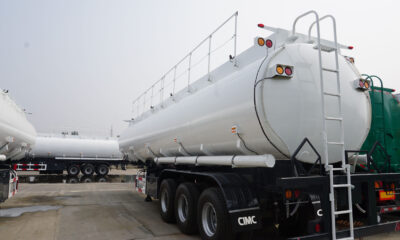





A truck carrying grains fell on its side after crashing into a road median at Itowolo, along the Ikorodu axis of Lagos State, early Thursday, occupying the entire Bus Rapid Transit (BRT) lane.
The incident occurred at about 5 a.m. along the route inward Agric and towards Ogolonto, according to the Lagos State Traffic Management Authority (LASTMA), which disclosed the development on Thursday.
SEE ALSO: Lagos: LASTMA Announces Traffic Restrictions Along Route to Toll Gate
The agency identified the vehicle as a white 10-tyre mini truck and confirmed that no casualties were recorded in the accident.
LASTMA said its officers were at the scene managing the situation, while recovery of the fallen vehicle was expected to commence shortly.
Despite the truck occupying the entire BRT lane, the agency said the incident was not affecting traffic flow at the time of its update.
The authority shared the information to alert motorists to the incident and its ongoing response at the scene.

The Commissioner of Police in Ogun State, Bode Ojajuni, has urged the Police Officers’ Wives Association (POWA) to transform its skills acquisition centre in Abeokuta into an industrial hub to promote job creation, entrepreneurship and women’s empowerment.
According to a statement signed by the Police Public Relations Officer, DSP Oluseyi B. Babas eyi, on Thursday, Ojajuni made the call on Monday when he led members of the Ogun State Police Command’s Management Team on an inspection visit to the POWA Skills Acquisition Centre at the Command Headquarters, Eleweran, Abeokuta.
SEE ALSO: Wife Dies in Ogun House Fire as Police Take 56-Year-Old Husband Into Custody
During the visit, the POWA Acting Chairperson, Bolanle Adeoye, and members of the association’s executive received the commissioner and conducted him around the facility, including its photography and make-up studios.
The centre is designed to equip POWA members and members of the public with practical vocational skills, promote entrepreneurship and create sustainable livelihood opportunities, particularly for women and young people.
Ojajuni charged POWA to leverage partnerships with government agencies, private sector organisations, manufacturers, vocational institutions and development partners to transform the facility into a thriving industrial hub.
He emphasised that the centre’s vision should go beyond skills acquisition to include enterprise development, productive ventures and employment generation.
According to the statement, the commissioner stressed the need for the initiative to create opportunities for beneficiaries to become self-reliant and contribute meaningfully to economic growth.
Ojajuni also highlighted the relationship between economic empowerment and crime prevention, noting that sustainable livelihoods could help address socio-economic factors associated with criminal activity.
He stressed that the centre could contribute to public safety through crime-prevention awareness, constructive community engagement and opportunities that encourage women and young people to pursue legitimate and productive ventures.
Commending Adeoye and the POWA Ogun State executive for their commitment to human capital development, the commissioner pledged the command’s support for the centre.
He reaffirmed the command’s readiness to encourage strategic collaboration and partnerships that would advance the facility’s development, expand its reach and strengthen its contribution to empowerment and community safety.
The Ogun State Police Command reiterated its commitment to supporting initiatives that promote productive engagement, strengthen community resilience and advance public safety across the state.

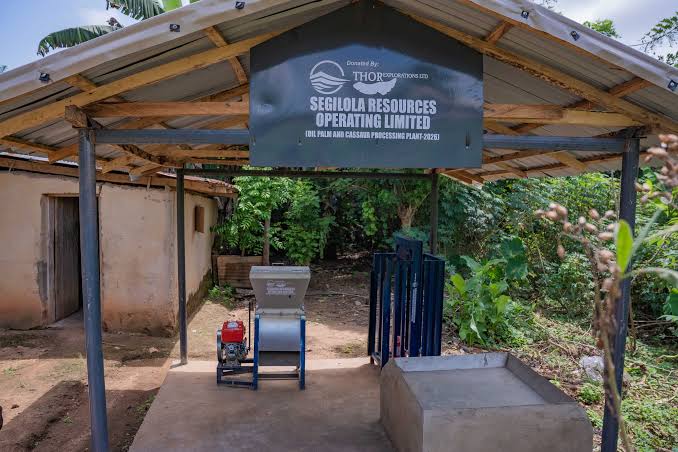
Thor Explorations Limited, through its Nigerian subsidiary, Segilola Resources Operating Limited (SROL), has provided 10 cassava and oil palm processing plants to host communities in Osun State to boost agricultural businesses, improve local livelihoods and create economic opportunities.
The initiative, which covers Imogbara, Odo-Ijesha and Iperindo communities, combines a 50 per cent equipment subsidy with a hire-purchase arrangement to help local processors acquire modern equipment and expand their businesses.
The project comprises six oil palm processing plants and four cassava processing plants allocated to selected beneficiaries across the three communities.
READ ALSO: FG Puts Daily Gas Output at 8bcf
Under the allocation, Iperindo received two oil palm plants and two cassava plants, while Imogbara and Odo-Ijesha each received two oil palm plants and one cassava plant.
Thor said the initiative was designed to address the challenges faced by local processors who rely on labour-intensive methods that limit production, increase processing time and reduce potential earnings.
Each oil palm processing plant comprises a vertical palm fruit debuncher and a diesel-powered automatic presser. The debunchers can process between 800 and 1,000 kilogrammes of palm fruit per hour, reducing the manual effort required to separate the fruits from their bunches.
The cassava processing plants are equipped with graters, manual pressers fitted with 32-tonne jacks and fryers for garri production.
Each grater can process up to 500 kilogrammes of cassava per hour, while the pressers remove excess water from grated cassava before further processing.
The company said the equipment would reduce strenuous manual work, improve processing efficiency and consistency, and enable beneficiaries to handle larger volumes of agricultural produce.
The subsidy and hire-purchase arrangement is also intended to make the equipment more affordable while encouraging business ownership, accountability and long-term maintenance.
Thor said agriculture remained an important source of livelihood in its host communities, adding that improved processing capacity would help local entrepreneurs build stronger businesses and participate more effectively in agricultural value chains.
Beyond the direct benefits to processors, the company expects the project to stimulate economic activities in transportation, trading and distribution, while improving product quality and creating opportunities for related local services.
The initiative forms part of Thor’s wider community investment programme implemented through SROL, which also covers women’s enterprise, education and livelihood restoration.
The company said the intervention reflected its commitment to strengthening local economies and creating sustainable livelihood opportunities in communities surrounding its Segilola Gold Mine.






Peter Obi Meets UK Officials, Diaspora Stakeholders on Rebuilding Nigeria

Grains-Laden Truck Falls on BRT Lane in Lagos

Ogun Police Chief Urges POWA to Turn Skills Centre into Industrial Hub

Thor Empowers Host Communities with 10 Cassava, Palm Oil Processing Plants

FG Puts Daily Gas Output at 8bcf

With Crude at $111, IEA Sees Prolonged Crisis

Trump’s Family Unveils New Cryptocurrency Platform

Senate Denies Receiving Petitions Against Tinubu’s Ambassadorial Nominees

Dangote Cement Lights Up Benue Host Communities With CSR Initiatives

Reps Recommend 3-year Jail Term For Aviation minister

Tems Sets New Record On Billboard Hot 100 Chart
