
NEWS
Edo Moves Strongly On Rural Healthcare


The Edo State Government, under the leadership of Governor Monday Okpebholo, has launched a transformative rural healthcare agenda, set to rewrite the story of healthcare delivery across the state’s under-served communities.
With an audacious policy direction rooted in access, equity, and sustainability, the administration is not only investing in physical infrastructure but also in the long-term dignity and health of the Edo people.
Governor Okpebholo’s rural health revolution is anchored on the state’s development blueprint: “SHINE”: “Security, Health, Infrastructure, Natural Resources, and Education”.
ALSO READ: NGX Reveals Results of Half-Year Review of Market Indices
Under the “Health” component of this agenda, the administration is breaking historical barriers to medical access by prioritizing rural communities often left behind in national conversations about public health.
On the impact of the new healthcare direction, Edo State Commissioner for Health, Dr. Cyril Oshiomhole stated that the Okpebholo administration has set in motion one of the most robust and inclusive health reforms in the history of the state.
“We understand that government cannot do everything alone,” Dr. Oshiomhole explained.
“But when the privileged help to insure the vulnerable, especially through our diaspora networks, we move closer to achieving near-total health coverage,” he added.
At the heart of this new direction is a grassroots-driven health insurance model that extends subsidized medical plans to rural dwellers who previously lacked access to even the most basic healthcare services. These plans are designed not as charity but as “sustainable social investments” that will serve as the financial foundation for revitalizing primary healthcare centres across the state.
“With a vibrant and well-funded health insurance scheme, we can fix our healthcare infrastructure and ensure these facilities are operational, well-staffed, and accountable,” Dr. Oshiomhole emphasized.
In addition to expanding insurance coverage, the government is investing heavily in public health education, infrastructure rehabilitation, and human capacity development.
A team of health educators has been deployed to communities across all three senatorial zones, where they are engaging in direct, in-language sensitization on hygiene, vaccination, and general wellness practices.
The state is also responding proactively to emerging health concerns. In the wake of the recent diphtheria outbreak, the Ministry of Health, in collaboration with the Nigerian Centre for Disease Control (NCDC) and the University of Benin Teaching Hospital (UBTH), launched a state-wide surveillance and vaccination campaign. So far, 15 suspected cases have been reported, with six confirmed and three fatalities.
“We are not waiting for numbers to escalate before taking action,” the Health Commissioner stated. “We are actively educating communities, administering booster doses, and prioritizing early intervention. Diphtheria is vaccine-preventable, and we are doing everything to ensure people understand this.”
Despite challenges such as vaccine misinformation and logistical bottlenecks, the state’s commitment remains firm. “We are not making pronouncements from air-conditioned offices. We are in the field, sitting with people, countering myths with facts,” Dr. Oshiomhole said.
Governor Okpebholo’s health revolution also includes strong partnerships with the media to deepen public awareness. The government is working closely with the Nigeria Union of Journalists (NUJ) and other media platforms to amplify health messages and encourage citizen participation. “The media is not just a mouthpiece. They are partners in this revolution. Their role is critical in ensuring our message reaches every ward and household,” the Commissioner affirmed.
This comprehensive approach: combining policy, infrastructure, human capital, and community participation, underscores the administration’s vision for a health system where every Edo citizen, regardless of location or income, has access to dignified, life-saving care.
Governor Okpebholo’s leadership is reshaping healthcare delivery in Edo State into a model of compassion, clarity, and competence. The administration’s focus is not on short-term projects but on long-term systems that will outlast political cycles and transform the lives of future generations.
With momentum building, community trust growing, and national partners lending support, Edo State is well on its way to becoming a model of rural healthcare transformation in Nigeria.







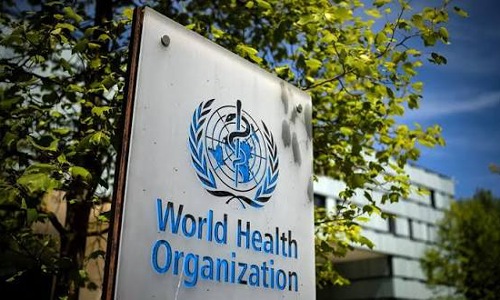
The World Health Organization (WHO) has released a disturbing update on the escalating conflict involving the United States, Israel, and Iran, revealing that thousands of people have been killed or injured in just under two weeks.
WHO Director-General Tedros Adhanom Ghebreyesus warned that health systems across the Middle East are under “immense strain” and are at risk of complete collapse if the crisis continues.
SEE MORE: US-Israel-Iran War: Day Four Updates from the Middle East
According to WHO reports, Iran has suffered over 1,300 deaths and around 9,000 injuries, while Lebanon has recorded at least 570 deaths and approximately 1,400 injuries.
In Israel, at least 15 people have died and more than 2,100 have been injured since hostilities escalated.
The conflict began on February 28, following a massive joint strike by US and Israeli forces that targeted top Iranian officials, including the country’s Supreme Leader.
The violence has since spread across the region, with retaliatory attacks targeting Israeli sites and US military bases in neighboring countries.
The humanitarian impact is severe. Over 100,000 Iranians and up to 700,000 Lebanese citizens have been displaced, many living in overcrowded conditions with limited access to clean water, sanitation, and medical care.
The WHO warns that these conditions put women and children at particular risk of disease outbreaks.
The organization also highlighted a growing trend of attacks on healthcare infrastructure, reporting dozens of strikes on hospitals and medical facilities across Iran and Lebanon.
Such attacks have not only resulted in deaths but also deprived entire communities of critical medical care when they need it most.
Tedros emphasized the urgent need for all parties to respect international law and protect civilians, calling for unimpeded humanitarian access and immediate measures to prevent the collapse of fragile health systems.
With the conflict continuing to escalate, the WHO has stressed that immediate action is required to protect lives, ensure medical support reaches affected populations, and prevent the humanitarian crisis from worsening.
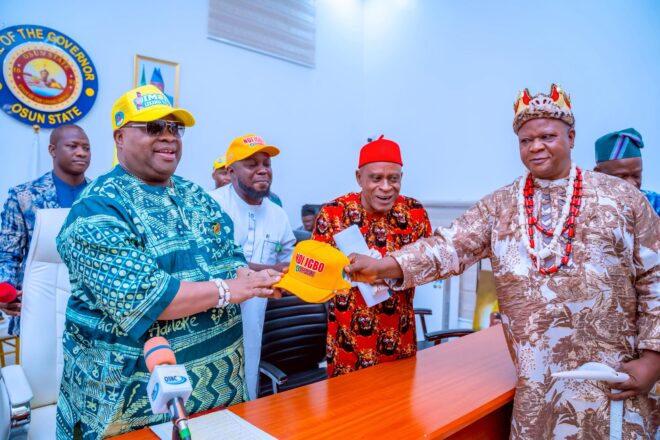
Ahead of the 2026 governorship election, the Ndigbo community across the local government areas of Osun State has declared its support for the second-term bid of Governor Ademola Adeleke.
A government house statement in Osogbo on Wednesday night has it that ndi Igbo cited his administration’s developmental strides across the state for their decision.
The endorsement was made during a courtesy visit by leaders of the Igbo community in Osun to the governor at the Government House in Osogbo, where they commended his leadership and commitment to inclusive governance.
ALSO READ: Adeleke on Why he Deserves Second Term
Speaking on behalf of the association, President-General of the Ndigbo in the state, Chief John Dike, praised the governor for the infrastructural and social development projects being carried out across the state.
He particularly commended the governor for appointing some members of the Igbo community as Senior Special Assistants, describing the gesture as a sign of recognition and inclusion of the community in the affairs of the state.
Chief Dike, however, appealed for further inclusiveness, requesting that more Igbo indigenes be considered for appointments into the state cabinet and other employment opportunities within the government.
He also urged the state government to allocate land for the construction of a modern secretariat for the Igbo community and grant approval for an endorsement rally in support of the governor’s re-election bid.
In addition, the Ndigbo leader sought assistance for Igbo farmers operating within the state, while assuring the governor of the community’s unwavering support for his administration and second-term ambition. Members of the delegation also presented campaign caps to the governor as a symbol of their solidarity.
Responding, Governor Adeleke expressed appreciation for the endorsement, noting that the Igbo community has continued to contribute positively to the social and economic development of the state.
He assured them that his administration would continue to promote their welfare and support their progress, while granting the requests presented during the visit.
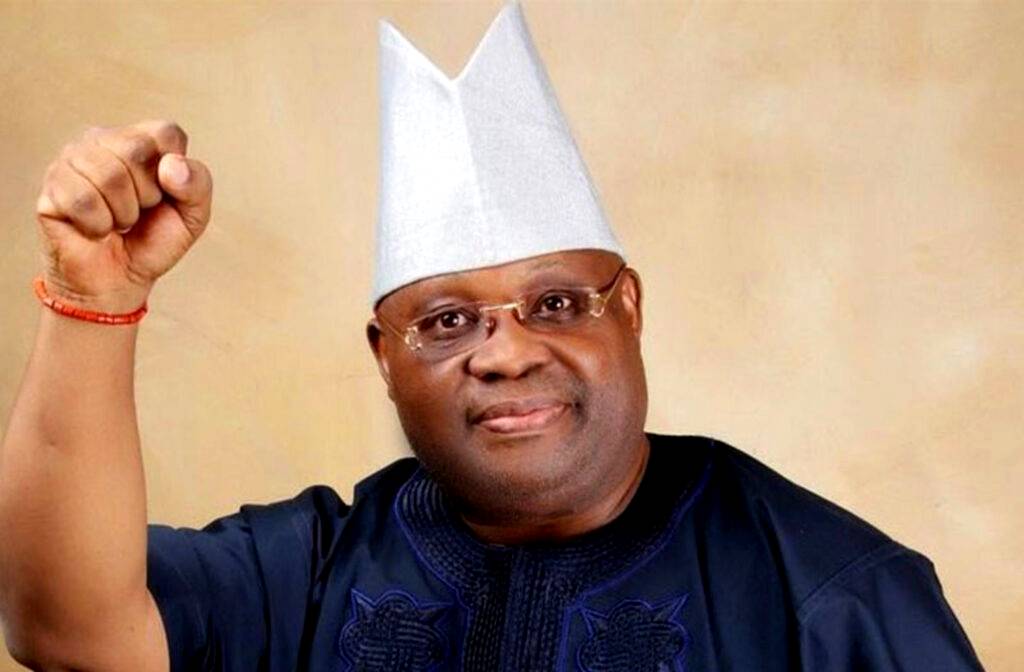
Osun State Governor, Senator Ademola Jackson Nurudeen Adeleke, has declared that his administration’s record of performance and fulfilment of electoral promises justifies a second term in office.
A government house statement in Osogbo on Wednesday has it that the governor made the declaration while hosting a delegation of the Ansar-Ud-Deen Society of Nigeria (ADS), Osun State Council, during a courtesy visit to the Government House, Osogbo.
ALSO READ: CNG: Tinubu Orders Deployment of 100,000 Kits in Three Weeks
It was gathered that the delegation was led by the National Vice President of the society, Asiwaju Justice Adeigbe (Rtd), alongside the Chairman of the Osun State chapter, Chief Daud Oladapo.
Speaking on behalf of the delegation, the State Secretary of the society, Dr Afeez Akande, praised the Governor’s performance and pledged the support of the organisation for the continuity of the administration.
“We have been following what you are doing and your track records. You are wonderful and you are marvelous in our eyes. The monumental works you have been doing in Osun make it look like we have never had a Governor like this before,” Dr Akande said.
He noted that the administration’s projects are known for timely delivery and strategic impact on the lives of residents.
“We have identified that once you embark on projects, they are time-bound. It shows genuine administrative acumen, love for the state and love for the people,” he added.
Dr Akande also cited infrastructural developments, specifically the ongoing dualisation of roads, notably that of Iwo as an example of the Governor’s vision-driven leadership.
“That road project has helped to boost economic activities in the area. Such development can only come from someone with vision who follows through with implementation. We appreciate what you are doing and we are resolved to support the continuity,” he said.
Responding, Governor Adeleke thanked the delegation for the visit and reaffirmed his commitment to people-centred governance.
“Today marks the starting point of campaigning for the August 15, 2026 governorship election. We need your prayers and support for a free and fair election through which the will of the people will prevail,” the Governor said.
Governor Adeleke also unveiled an upgraded Five-Point Agenda that will drive his re-election campaign.
“Our reloaded Five-Point Agenda will focus on integrated youth, women and workers’ welfare and empowerment; infrastructure consolidation for citizens’ social and economic wellbeing; agro-industrial expansion for human development and collective prosperity; affordable and qualitative health and education access; and an improved and secured business environment for job creation,” the Governor stated.
Explaining why he deserves a second term, the Governor pointed to the administration’s record across several sectors.
“When the opposition asked whether I deserve to be re-elected, I told them yes based on my performance in this first term in office,” the Governor said.
“I deserve re-election because of what our administration has delivered for the people of Osun. We have empowered the cooperative movement with almost four billion naira, strengthened community development associations with grassroots health and infrastructure projects, and implemented the Imole Medical Outreach that has benefited almost eighty thousand residents.”
He added that the administration has also revived agriculture and rural development across the state.
“We revived the cocoa revolution through aggressive seedling distribution and new farmers’ initiatives, acquired brand new tractors now serving farmers across the state, and implemented thousands of local projects through integrated rural development under the O-RAMP programme,” he said.
Governor Adeleke further highlighted achievements in governance, infrastructure and economic management.
“We introduced a 45-day window for the acquisition of Certificates of Occupancy, revived the Osun Free Trade Zone with active investors, digitised tax and revenue collection, and implemented the SIFMIS payroll application to ensure transparency in the management of public funds,” he stated.
The Governor also cited major achievements in infrastructure and social services.
“We have constructed over 350 kilometres of roads, developed three major flyover bridges, revived six moribund waterworks, drilled 332 boreholes across wards, rehabilitated schools and health centres, and paid inherited half salaries and almost one hundred billion naira in pension debts,” he added.
Governor Adeleke assured the people of Osun that his administration will continue to deliver inclusive governance and sustainable development if re-elected.
“My promise to the people of Osun is that now and when we are re-elected, we will continue to run an inclusive and forward-looking government that keeps the people at the centre of our programmes and policies,” he said.
Other dignitaries, and political functionaries present included the Deputy Governor of Osun State, Prince Kola Adewusi, and the Head of Service, Elder Ayanleye Aina.






WHO Releases Alarming Casualty Figures From US‑Israel‑Iran Conflict

PDP’s Festering Crisis Chases Tambuwal to ADC

$200/barrel Price Likely as Iran Threatens Oil Ships

2026 Poll: Osun Ndigbo Backs Adeleke’s Second-Term Bid

NGX Group, IFC, CSCS and WIMBIZ Convene Leaders to Advance Gender Equality at 2026 Ring the Bell Ceremony

Adeleke on Why he Deserves Second Term

Trump’s Family Unveils New Cryptocurrency Platform

Reps Recommend 3-year Jail Term For Aviation minister

Dangote Cement Lights Up Benue Host Communities With CSR Initiatives

Senate Denies Receiving Petitions Against Tinubu’s Ambassadorial Nominees

Things To Know About Threads, Zuckerberg’s Twitter-like App

c8h2jj