
NEWS
Okpebholo Dangles Chinese Varsity Exchange Programme Before Students

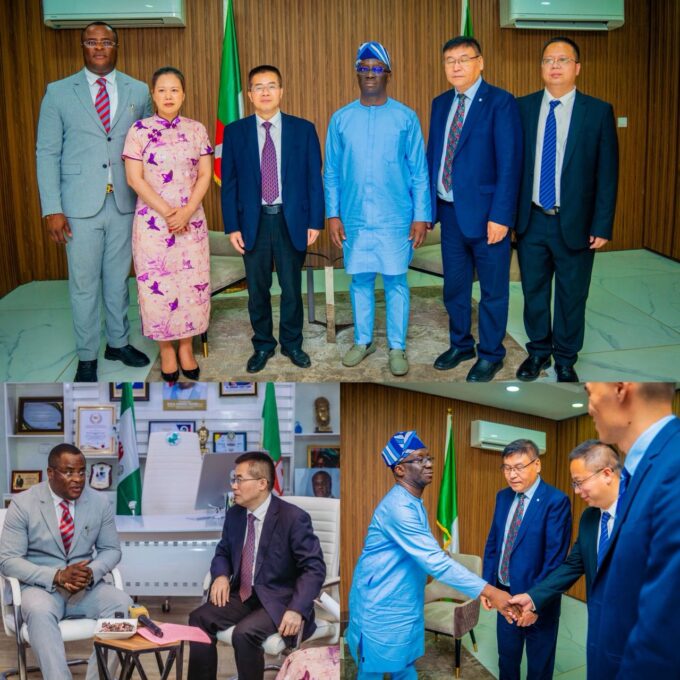
The Edo State Government and the Federal Republic of China are exploring avenues for institutional collaboration aimed at deepening the exchange of knowledge across education, culture, and technology.
Governor Monday Okpebholo received a high-level delegation from Fujian Jiangxia University, China, led by the President of the institution, Mr. Ling Qzdan, during a courtesy visit to Government House, Benin City.
The delegation expressed keen interest in partnering with Edo State Government to advance bilateral cooperation between academic institutions in both regions.
Welcoming the delegation, Governor Okpebholo remarked that his administration had long anticipated such an engagement, emphasizing that meaningful partnerships with nations like China are critical for sustainable knowledge transfer and capacity development.
ALSO READ: Dangote Offers Transport-free Deliveries on PMS, Diesel, Aviation Fuel
“We are delighted to welcome you to Benin City; one of the oldest cities in Africa and the world, rich in cultural heritage and history,” the governor stated.
“News of your visit brought us great joy, as this collaboration with China is one I have earnestly looked forward to. It presents an opportunity to exchange knowledge across education, culture, science, and technology. Learning is a lifelong pursuit, and the transfer of knowledge is central to our administration’s vision for transformation.”
Governor Okpebholo further emphasized Edo State’s cultural depth and expressed optimism that China would benefit from the richness of Edo’s heritage, just as Edo State stands to gain from China’s technological advancements.
“This partnership, particularly the agreement between Fujian Jiangxia University and Ambrose Alli University (AAU), is of immense value to us. We are excited by the possibilities and believe that this collaboration will be mutually beneficial. We look forward to sharing our culture with China and gaining insights from your educational and technological systems.”
In his remarks, Mr. Ling Qzdan, President of Fujian Jiangxia University, explained that the purpose of the visit was to formalize cooperation and strengthen institutional ties in the domains of education, culture, technology, and scientific research.
He observed that both institutions: Fujian Jiangxia University and Ambrose Alli University, share similar facilities and academic disciplines, which provide a strong foundation for long-term collaboration.
“This visit is intended to consolidate a robust partnership between Fujian and Benin City, particularly in education and cultural exchange,” Mr. Qzdan noted.
“We believe that through joint initiatives and leadership dialogue, we can significantly deepen collaboration and foster academic excellence. We are here to seek meaningful cooperation with Edo State’s educational sector and to promote mutual learning and understanding between our people.”
Speaking at the event, the Edo State Commissioner for Education, Dr. Paddy Iyamu described the partnership as a strategic milestone that will reshape the future of education in the state.
“The purpose of this visit is to facilitate institutional collaboration between Edo State and China,” he explained. “By September, we will begin finalizing the documentation to initiate a technical agreement between Fujian Jiangxia University and our own Ambrose Alli University. This is a remarkable step forward.”
The Commissioner reaffirmed the Governor’s commitment to ensuring that every Edo child is equipped to compete globally, adding that reforms are underway to dismantle systemic barriers to education.
“We are committed to building a globally competitive student population grounded in science, technology, and life skills. The Governor has made it clear that Edo children must not only participate in but lead innovation.
The Chinese are global leaders in infrastructure and technological advancement. Their integration into our educational ecosystem will not only bolster learning outcomes but also stimulate broader economic development.”
The visit marks a significant step toward international academic and cultural cooperation and reflects Edo State’s commitment to global engagement in education and human capital development.









Otunba Segun Showunmi, a member of the Tinubu/Shettima Presidential Campaign Council (PCC) for 2027, has urged the South-East to assess President Bola Tinubu’s administration based on verifiable projects and measurable results rather than political propaganda.
Showunmi made the call in a statement posted on X on Saturday, urging Nigerians to evaluate the government’s performance based on infrastructure delivery, funds committed to projects and their impact on communities.
He said federal infrastructure initiatives targeting the South-East under Tinubu’s administration deserved serious scrutiny and factual assessment, adding that unfulfilled promises should continue to be pursued until the expected results were delivered.
SEE ALSO: 2027 Election: ‘Look Beyond the Noise’ – Showunmi Urges Nigerians to Give Tinubu More Time
“Our message is clear: We will not trade facts for propaganda, nor accountability for political loyalty!” he said.
The political figure challenged critics of the administration to provide evidence to support their claims, while urging those defending the government to present the projects and demonstrate their impact.
He also called on government officials to publish relevant figures, disclose project timelines and provide measurable results, insisting that no public official should be exempt from scrutiny.
According to Showunmi, the South-East deserves infrastructure that supports economic growth, including roads that connect markets, investments that create jobs and policies that expand economic opportunities.
He maintained that political representation must translate into tangible benefits for citizens, stressing that public office should deliver value to the people.
As part of his call to action, Showunmi urged Nigerians to scrutinise government records, challenge misinformation with evidence and demand the completion of outstanding projects.
He further called for public commitments to be matched by measurable delivery, arguing that leadership should be assessed by facts and results rather than political rhetoric.
Ending his statement with the slogan, “Asiwaju is a goal,” Showunmi called for accountability and greater inclusion of the South-East in Nigeria’s development.
Showunmi is associated with The Alternative and is a member of the Tinubu/Shettima Presidential Campaign Council for the 2027 elections.

The Lagos State Traffic Management Authority (LASTMA) on Saturday announced a temporary road closure near Apostolic Church, inward Toll Gate, to allow engineers to install a beam on a height-restriction structure.
The agency said the installation was aimed at preventing high-rise trailers from accessing the newly constructed pedestrian bridge.
ALSO READ: LASTMA Alerts Motorists to Traffic Delays on Ogunnusi Road
“Currently, one lane has been occupied to facilitate the ongoing construction work, while the remaining two lanes are available to motorists,” LASTMA stated.
The agency advised road users to approach the affected corridor with caution and follow the directions of its personnel deployed to the area.
“Road users are advised to approach the affected corridor with caution and follow the directions of our personnel who are on ground to ensure the smooth flow of vehicular movement,” the statement added.
LASTMA also urged motorists to remain patient while the installation work continued.
“Motorists are encouraged to exercise patience while the installation work is in progress,” the agency stated.
Nigerian national Ekene Chukwuma has said he returned to Nigeria with assistance linked to Oseni Rufai rather than the Nigerians in Diaspora Commission (NiDCOM), while renewing allegations against the commission’s chairperson, Abike Dabiri-Erewa, over his travel documents.
Chukwuma made the remarks in an interview in which he explained how he returned to Nigeria after spending months at a deportation camp in India.
RELATED NEWS: Rufai Oseni Row: NiDCOM Breaks Silence on Nigerians Detained in India, Addresses Ekene’s Case
“My name is Kenneth Chukwu, from Enugu State,” he said, introducing himself before explaining how he returned to the country.
“I came back here with the assist of Osini Roufai, a good friend of him,” he said.
Chukwuma denied that NiDCOM facilitated his return, alleging that the commission had published false information about his case.
“NiDCOM made a lots of false, uh, news acquisition against me, which is still in Abike Dabiri handle in Twitter,” he said.
He also accused Dabiri-Erewa of sharing his expired international passport and a travel certificate he claimed was issued six months after he entered the detention camp.
“He also, she also posted my international passport that expired. He also, she also posted my TC that issued after 6 months,” he said.
His comments renew questions surrounding the handling of his case and the circumstances under which he obtained the documents needed to return to Nigeria.
Chukwuma’s detention in India previously sparked a public disagreement between ARISE News presenter Oseni Rufai and Dabiri-Erewa over NiDCOM’s response to reports of his situation.
Oseni raised concerns about Chukwuma’s detention and the commission’s handling of the case, while Dabiri-Erewa defended NiDCOM’s position and explained the process for submitting information to the commission.
NiDCOM subsequently issued its account of Chukwuma’s detention, stating that he had been arrested in India over a visa overstay and addressing the circumstances surrounding his travel documents.
The differing accounts prompted public debate about the commission’s response to Nigerians facing immigration difficulties abroad.






Showunmi Urges South-East to Judge Tinubu by Projects, Not Propaganda

2027: ‘North Has No Reason to Break Agreement’ — Gov Yusuf Backs Tinubu

Aircraft Averts Crash, After Losing Door Mid-Air in Abuja

Bandits Kill 70-Year-Old Man in Katsina, 27 Victims Rescued

‘Nigeria Is Doomed Under Tinubu’ — Kenneth Okonkwo Backs Atiku for 2027

Lagos: LASTMA Announces Traffic Restrictions Along Route to Toll Gate

Trump’s Family Unveils New Cryptocurrency Platform

Senate Denies Receiving Petitions Against Tinubu’s Ambassadorial Nominees

Dangote Cement Lights Up Benue Host Communities With CSR Initiatives

Reps Recommend 3-year Jail Term For Aviation minister

Tems Sets New Record On Billboard Hot 100 Chart

wthrtu