
Energy
PMS, Diesel Distribution: Dangote Deploys 4,000 CNG Tankers Nationwide

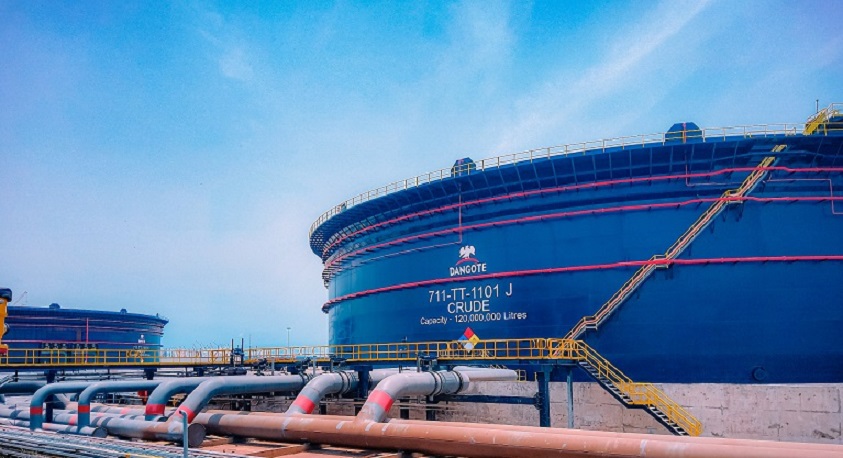
. . . Offer open to Marketers, Petrol Dealers, Manufacturers, Telecoms Firms, Aviation and other large users
Dangote Petroleum Refinery has announced the commencement of a significant national initiative designed to transform Nigeria’s fuel distribution landscape.
Effective 15th of August 2025, the Refinery will begin the distribution of Premium Motor Spirit (PMS) and diesel to marketers, petrol dealers, manufacturers, telecoms firms, aviation, and other large users across the country, with free logistics to boost distribution network.
To ensure smooth take-off of this scheme, Dangote Refinery has invested in the procurement of 4,000 brand-new Compressed Natural Gas (CNG)-powered tankers. This phase of the programme will continue over an extended timeframe. The refinery is also investing in Compressed Natural Gas (CNG) stations, commonly referred to as daughter booster stations, supported by a fleet of over 100 CNG tankers across the country to ensure seamless product distribution.
This strategic programme is part of our broader commitment to eliminating logistics costs, enhancing energy efficiency, promoting sustainability and supporting Nigeria’s economic development. It affirms our dedication to improving the availability and affordability of fuel, in support of broader efforts to strengthen the economy and improve the well-being of all Nigerians.
ALSO READ: Aliko Dangote Steps Down As Dangote Sugar Chairman After 20 Years
Under this initiative, all petrol stations purchasing PMS and diesel from the Dangote Petroleum Refinery will benefit from this enhanced logistics support. Key sectors such as manufacturing, telecommunications, and others will also gain from this transformative initiative, as reduced fuel costs will contribute to lower production costs, reduced inflation, and foster economic growth. Players in these key sectors and others can purchase directly from the Dangote Petroleum Refinery.
In addition, the refinery will offer a credit facility to those purchasing a minimum of 500,000 litres—allowing them to obtain an additional 500,000 litres on credit for two weeks, under bank guarantee.
This pioneering effort marks a major milestone in our vision to revolutionise Nigeria’s energy sector. Dangote Refinery is dedicated to ensuring that no place is left behind. Our goal is to provide equitable access to affordable fuel for all Nigerians, regardless of location, making energy more accessible and sustainable for everyone, wherever they may be.
It is expected to revitalise previously inactive petrol stations, thereby driving job creation, stimulating small and medium-sized enterprises (SMEs), increasing government revenue, improving fuel access in rural and underserved communities, and strengthening investor confidence in Nigeria’s downstream petroleum sector.
This initiative is inline with the Renewed Hope Agenda of His Excellency, President Bola Ahmed Tinubu, reflecting our shared commitment to economic progress, stability, and inclusive development. We sincerely thank the Federal Government for its continued support, especially through the Naira-for-Crude scheme, which has helped stabilise fuel supply amid global price volatility. It marks a major revolution in the midstream and downstream sectors and stands as a key example of President Bola Tinubu’s bold and reformative economic policies.
We invite marketers, petrol dealers, manufacturers, telecom companies, and all key stakeholders to embrace this landmark initiative. The registration process, including Know Your Customer (KYC) verification, will take place from 16 June to 15 August, spanning a total of 60 days. For enquiries, please call +234 707 470 2099, +234 707 470 2100, +234 816 961 8390, +234 703 796 8308, +234 812 362 2893. Email: Email: [email protected].
The Dangote Petroleum Refinery remains a proud partner in this national journey— a truly Nigerian company of global standards, dedicated to the well-being of all Nigerians.







Joseph Ambakederimo, convener of the South-South Reawakening Group, has questioned the accountability of Nigeria’s crude oil forward sales, demanding clarification on the volume of crude lifted, outstanding balances and the use of upfront payments.
Speaking during an interview on Arise TV on Sunday, Ambakederimo expressed concern over the monitoring of crude oil transactions, questioning who was responsible for tracking deliveries and providing feedback on the arrangements.
“We don’t even know who is monitoring and giving us the feedback of the barrels of crude that have been lifted on forward sales basis,” he said.
SEE MORE: South-South Group Opposes Coastal Road Alignment With East-West Road
He challenged the Nigerian National Petroleum Company Limited (NNPC) to provide details of the transactions, including the quantity of crude already lifted, the outstanding balance and whether the agreed deliveries had been completed.
“Today, can we get this from NNPC? How much have they lifted? What is the balance remaining? Have they been completed?” he asked.
Ambakederimo also questioned how the money collected upfront under the arrangements had been spent, demanding an explanation of its use.
“That money that was collected upfront, what was the use of the money? Can you justify it?” he asked.
He argued that Nigeria should make better use of its natural resources to accelerate infrastructure development and improve living conditions.
Citing land reclamation projects in the United Arab Emirates, Ambakederimo said Nigeria could explore similar opportunities to create additional land for residential and other developments.
He recalled seeing a signpost while travelling from Dubai to Abu Dhabi describing a project to reclaim land from the sea, using the example to highlight the development possibilities he believes Nigeria could explore.
The South-South Reawakening Group convener also argued that Nigeria could reclaim land in suitable areas, provided environmental concerns were properly managed.
He called for the country to translate its natural resource wealth into infrastructure and improved living conditions, stressing the need for greater accountability in crude oil transactions.
Oil output from the United Arab Emirates (UAE) rose to record levels in September, underscoring its resilience even amidst the Middle East crises and liberation from OPEC+ limits.
The International Energy Agency (IEA) issued the data in its monthly report, adding that Abu Dhabi raised total oil production, including condensates, by 400,000 bpd to 5.3 MMbpd.
According to the IEA, the UAE bolstered crude output to more than 4.4 MMbpd, nearing its maximum capacity, which surpasses the previous highs for total oil in August, and crude oil in June.
READ ALSO: Africa’s Energy Security Conversations Pull Industry Executives Together
The UAE has been one of the most successful among regional producers in restoring flows through the Strait of Hormuz, by drawing on a fleet of tankers to discreetly shuttle cargoes through the chokepoint and then transfer them onto other vessels. In addition, the country’s decision to leave the Organization of the Petroleum Exporting Countries (OPEC) as of May has freed it from the group’s output caps, a source of frustration for years.
Its gains contributed to a wider recovery in flows from Gulf producers, which reached more than 75% of pre-war levels in September, led by Saudi Arabia, according to the Paris-based IEA.
Still, it’s unclear how far the regional rebound has withstood a new wave of Iranian attacks on tankers transiting Hormuz, and escalating hostilities carried out by the Houthi rebel faction in Yemen.
The UAE depleted its observable above-ground inventories at a record pace of more than 270,000 bpd in September, drawing them to an all-time low, according to the IEA.
Africa’s gas potential and strengthening the continent’s energy security would take centre stage at the Africa Interviews Sustainability Forum (AISF 2026) scheduled for Wednesday, October 21, in Lagos.
Biztellers reports that top officials of Oando Plc and Renaissance Africa Energy Company Limited, Ayotola Jagun and Tony Attah, respectively, will be leading other industry leaders in the discussion.
Jagun, Oando’s Executive Director, Chief Corporate Services and Sustainability Officer, and Attah, Managing Director and Chief Executive Officer of Renaissance Africa Energy Company Limited, will participate in a panel discussion alongside Lamé Verre of Lean In Equity & Sustainability (LiNES) and Dapo Filani, Managing Director and Chief Executive Officer of Waltersmith.
The panel will examine Africa’s energy security and the role of natural gas in the continent’s energy transition.
READ ALSO: 30 Nigerians Bag Postgraduate Scholarship from NNPC Ltd, Eni
The forum, launched in 2024, is holding its third edition under the theme, “Energy Security and Africa’s Energy Transition: Defining the Role of Gas.”
This year’s gathering will explore how African countries can strengthen energy security, attract investment in gas development and balance growing energy demand with sustainability objectives.
Verre, a London-based energy and sustainability executive, is Co-founder and Chair of the Advisory Board of LiNES. She will bring her international experience in sustainability, decarbonisation and low-carbon development to the discussion. Her work spans low-carbon initiatives across sectors, including marine, the built environment, forestry, land and agriculture.
Jagun brings extensive experience in corporate governance, regulatory compliance, enterprise risk management and sustainability. Her contribution will provide a corporate sustainability and governance perspective on the relationship between energy development, environmental responsibility and Africa’s transition priorities.
Attah, a former Managing Director and Chief Executive Officer of Nigeria LNG Limited, has extensive experience in the oil and gas industry, particularly in natural gas development and major energy operations.
Filani leads Waltersmith, an indigenous Nigerian energy company with interests across the oil and gas value chain. His participation will highlight the role of indigenous energy companies in strengthening domestic energy capacity and supporting economic development.
The panel will consider what is required to unlock greater investment in Africa’s gas sector, how natural gas can support industrial growth while advancing sustainability, and what practical measures could help translate the continent’s energy ambitions into tangible outcomes.
Beyond the panel discussion, AISF 2026 will provide opportunities for engagement among senior energy executives, policymakers, investors and business leaders.






Sanwo-Olu Pledges Full Support as Lagos Prepares to Host 2026 CAF Awards

JUST IN: Presidency Rejects Makinde’s Claim of ₦250bn NLNG Dividends for Each State

Sowore Challenges Okonjo-Iweala to Name Those Behind Alleged $2.4bn Subsidy Fraud

Tinubu vs Obi: Omokri Fires Back at Peter Okoye Over Call to Retire Older Politicians
Kwankwaso Rejects ADC Claims, Says NDC Won’t Withdraw From 2027 Race
‘World Bank’s 124% Debt Interest Figure Misleading’ – Finance Ministry Insists

Trump’s Family Unveils New Cryptocurrency Platform

Senate Denies Receiving Petitions Against Tinubu’s Ambassadorial Nominees

Dangote Cement Lights Up Benue Host Communities With CSR Initiatives

Reps Recommend 3-year Jail Term For Aviation minister

Tems Sets New Record On Billboard Hot 100 Chart

1fw4m7
vmy56f
Some truly prime posts on this internet site, bookmarked.
I am often to blogging and i really appreciate your content. The article has really peaks my interest. I am going to bookmark your site and keep checking for new information.
Its such as you read my thoughts! You appear to grasp so much approximately this, like you wrote the guide in it or something. I think that you just can do with some to force the message house a little bit, however instead of that, that is wonderful blog. A great read. I’ll definitely be back.
I like this post, enjoyed this one thank you for posting. “We are punished by our sins, not for them.” by Elbert Hubbard.
What i don’t realize is if truth be told how you are not really much more neatly-favored than you may be right now. You are so intelligent. You recognize thus significantly on the subject of this matter, made me in my view consider it from numerous various angles. Its like women and men don’t seem to be involved unless it is something to accomplish with Woman gaga! Your personal stuffs great. All the time take care of it up!
Yay google is my queen helped me to find this great web site! .
Woh I enjoy your posts, bookmarked! .
As I website possessor I believe the subject material here is very wonderful, thankyou for your efforts.
I just could not go away your web site prior to suggesting that I extremely enjoyed the standard info an individual supply on your visitors? Is going to be back steadily in order to check out new posts.
You made some decent points there. I did a search on the topic and found most persons will go along with with your site.
I believe this web site has got some real wonderful info for everyone. “There is nothing so disagreeable, that a patient mind cannot find some solace for it.” by Lucius Annaeus Seneca.
I see something really interesting about your web blog so I saved to bookmarks.
Pretty nice post. I just stumbled upon your weblog and wanted to mention that I have really enjoyed surfing around your weblog posts. In any case I’ll be subscribing in your rss feed and I am hoping you write once more very soon!
Hey very nice site!! Man .. Excellent .. Amazing .. I will bookmark your site and take the feeds also…I’m happy to find numerous useful information here in the post, we need develop more strategies in this regard, thanks for sharing. . . . . .
I haven?¦t checked in here for some time since I thought it was getting boring, but the last few posts are great quality so I guess I?¦ll add you back to my daily bloglist. You deserve it my friend 🙂
It is really a nice and useful piece of info. I’m happy that you just shared this useful information with us. Please stay us up to date like this. Thanks for sharing.