
International News
Political Turmoil In South Korea As President Yoon’s Impeachment Trial Begins


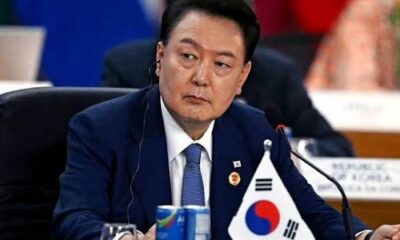
South Korea’s Constitutional Court opened the impeachment trial of President Yoon Suk Yeol on Tuesday, marking a pivotal moment in the nation’s political history following his controversial attempt to impose martial law.
The court’s first hearing was brief, adjourning shortly after it began at 2:00 pm (0500 GMT) due to Yoon’s absence.
A spokesperson confirmed the adjournment, stating the hearing lasted only minutes.
Yoon’s legal team cited “safety concerns” for his nonattendance, but the court plans to proceed with the remaining hearings as scheduled.
READ MORE: AGN President Responds To Reports Of Arrest In Umuahia
Yoon’s impeachment follows his December 3 directive for soldiers to storm parliament in an effort to block lawmakers from voting on his suspension of civilian rule.
The failed bid to impose martial law, South Korea’s first in over four decades, lasted just six hours and plunged the nation into its worst political crisis in decades.
The president was swiftly impeached and suspended from office. Since then, Yoon has remained at his residence, refusing summonses from investigators and relying on his presidential security team to resist arrest.
The Constitutional Court’s eight judges will assess whether Yoon’s declaration of martial law was unconstitutional or illegal—either of which would justify his removal.
A decision to uphold the impeachment requires six votes in favor.
The trial, which comprises five scheduled hearings, will continue Thursday, with additional sessions planned for January 21, January 23, and February 4. The court has until mid-June to deliver its ruling.
“This impeachment case focuses solely on the martial law situation,” said Kim Nam-ju, one of Yoon’s lawyers. “Since most of the individuals involved have already been indicted and the facts have been somewhat established, it doesn’t seem like it will take a long time.”
The National Assembly’s legal team has argued for swift action. “There are overwhelming reasons for the immediate dismissal of Yoon,” a representative said before the trial began Tuesday.
While the impeachment trial proceeds, a parallel criminal investigation into Yoon’s actions continues.
A joint team of investigators from the Corruption Investigation Office (CIO) and police is preparing another attempt to arrest the suspended president on insurrection charges.
A previous effort to detain Yoon was blocked by his security team, who have since fortified his residence with barbed wire, barricades, and increased patrols.
The defence ministry has clarified that nearby military units will not assist in any arrest attempts.
Yoon’s chief of staff, Chung Jin-suk, indicated a willingness to cooperate under specific conditions. “We are ready to consider all options for investigation or visits to the sitting leader at a third location,” he said.
If arrested, Yoon would become the first sitting South Korean president to face detention. A conviction on insurrection charges could result in life imprisonment or even the death penalty.
The impeachment trial comes as South Korea grapples with heightened political instability. Lawmakers also impeached Yoon’s stand-in last month, leaving the country’s leadership in disarray.
The acting president has called for dialogue and urged all parties to resolve the crisis peacefully.





International News
‘Another Oil Shock Is Coming’ — Badenoch Calls for North Sea Drilling Amid Middle East Supply Disruptions

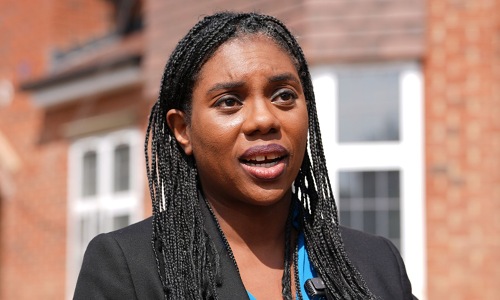
Conservative Party leader Kemi Badenoch has warned that another global oil shock could be looming amid disruptions to key energy infrastructure and shipping routes in the Middle East.
Badenoch made the warning in a post on X on Sunday, September 20, while pointing to the recent drone attack on Saudi Arabia’s East-West oil pipeline, restrictions affecting the Strait of Hormuz and threats to shipping around the Red Sea.
“Saudi Arabia’s East-West oil pipeline has been damaged by drone attacks. The strait of Hormuz is restricted, Houthi bandits threaten shipping routes into the Red Sea. Another oil shock is coming,” Badenoch wrote.
SEE MORE: Middle East Crises Pump Fuel Prices Upwards with Attacks on Iran, Saudi Arabia
She criticised the UK government’s handling of the situation and argued that Britain should increase domestic oil and gas production.
“Yet our Prime Minister and his Cabinet are behaving like a flock of ostriches, heads buried so deep in the sand they could strike oil themselves,” she added.
“The answer is simple: DRILL OUR OWN OIL AND GAS IN THE NORTH SEA.”
Saudi oil pipeline hit by drone attack
The warning comes after Saudi Arabia’s critical East-West oil pipeline was damaged in a drone attack earlier this month.
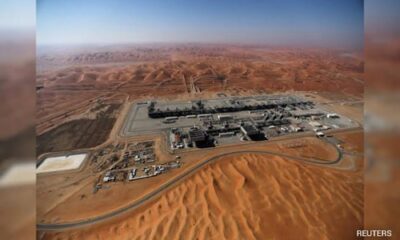
The 1,200-kilometre pipeline, operated by Saudi Aramco, transports crude oil across Saudi Arabia to the Red Sea port of Yanbu, providing an alternative export route when shipping through the Strait of Hormuz is disrupted.
Saudi officials said the September 11 attack involved drones coming from Iraq. No group had claimed responsibility for the attack in initial reports.
A subsequent Reuters analysis of satellite imagery found that three pumping stations, rather than two previously identified, had been damaged.
Industry sources disclosed that repairs could take between five and six weeks, although partial operations could resume sooner.
The pipeline had been carrying around 4 million to 5 million barrels of crude oil per day, equivalent to approximately 4% to 5% of global oil supply. Its shutdown has therefore raised concerns about additional pressure on already-disrupted global energy supplies.
The attack also affected Saudi oil exports.
Reuters reported on September 18 that Saudi Aramco had informed at least two European refining customers that they would receive no Saudi crude deliveries in October, following the pipeline disruption.
Hormuz and Red Sea disruptions
The pipeline attack has occurred against the backdrop of continuing disruption around the Strait of Hormuz, a major route for global oil shipments.
The East-West pipeline had become particularly important because it allowed Saudi Arabia to move crude to the Red Sea without relying entirely on the Strait of Hormuz. Reuters reported that the pipeline had served as a major alternative route while the strait was largely shut by the ongoing conflict.
Shipping through the Red Sea is also facing renewed security concerns following advances and attacks by Yemen’s Iran-aligned Houthi movement.
According to report on September 17, there is continued tensions involving the Houthis and Saudi Arabia were adding to concerns over regional energy infrastructure and shipping.
Earlier today, there are fresh Houthi claims of missile and drone attacks targeting strategic sites in Riyadh, with the developments contributing to renewed pressure on Saudi and Gulf markets.
International News
Nigeria Joins Global INTERPOL Operation as AI Identifies 126 Foreign Terrorist Fighters
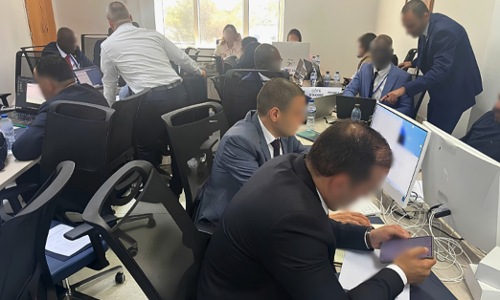
Nigeria has joined 10 other countries in a global counter-terrorism operation coordinated by the International Criminal Police Organization (INTERPOL), in which artificial intelligence was used to help identify 126 Foreign Terrorist Fighters.
Known as Operation Shams II, the five-day operation was conducted from June 1 to 5, 2026, in Tunis, Tunisia, and brought together 28 specialised officers and experts from 11 countries.
According to INTERPOL, law enforcement officers extracted 108,076 facial images from visual content published by jihadist groups during the operation.
SEE MORE: EFCC Warns Lawyers Against Charging Clients in Foreign Currencies
Programmed AI agents and advanced AI-generated scripts were then used to automate parts of the data collection and investigative process, including deduplicating and quality-checking the images.
The technology helped narrow the dataset to 6,362 unique, high-quality facial images, which were subsequently processed through INTERPOL’s Facial Recognition System.
INTERPOL said the AI-generated results were reviewed and verified by trained officers and analysts in accordance with its Rules on the Processing of Data.
“To date, 126 Foreign Terrorist Fighters have been identified from the images processed during Operation Shams II,” the organisation said.
INTERPOL explained that the matches would help enrich existing intelligence on the suspects, including information on their potential locations and social networks.
The intelligence is now being integrated into INTERPOL’s global databases as part of efforts to detect, track and disrupt terrorist movements worldwide.
The operation also received a large intelligence dataset related to terrorism suspects from officers at INTERPOL’s National Central Bureau in Baghdad, Iraq.
INTERPOL said hundreds more images were extracted from the dataset for processing.
Investigative leads generated during the operation are already being used to support judicial procedures in participating countries, including a case involving two currently detained suspected Foreign Terrorist Fighters.
INTERPOL said thousands of additional images are still awaiting processing, meaning further comparisons could produce additional investigative leads.
Beyond facial recognition, Operation Shams II also deployed cryptocurrency tools to trace illicit funding.
According to INTERPOL, the effort resulted in three urgent requests to a Virtual Asset Service Provider for customer data aimed at disrupting terrorist financing flows.
Participating countries also engaged representatives of the online gaming industry on the issue of youth radicalisation in online environments, with discussions focused on strengthening cooperation and information sharing.
INTERPOL Director of Counter-Terrorism, María Carmen Muñoz González, said the operation demonstrated the value of combining international law-enforcement cooperation with responsible AI-assisted analytical capabilities.
The participating countries were Côte d’Ivoire, Ghana, Iraq, Kenya, Malaysia, Nigeria, the Philippines, Qatar, Tajikistan, Tunisia and Uzbekistan.
INTERPOL said Operation Shams II was carried out under the CT TECH+ Project, funded by the European Union’s Foreign Policy Instruments and supported by the United Nations Office of Counter-Terrorism.
UN Women has renewed its call for equal pay for work of equal value, saying women around the world still earn, on average, 20 per cent less than men.
UN Women made the call on Friday, September 18, 2026, to mark International Equal Pay Day, warning that the persistent gender pay gap continues to affect women’s lifetime earnings, economic security and retirement benefits.
According to the organisation, the disparity is even wider for some groups of women, including migrant women, women with disabilities, and women from racial and ethnic minorities.
SEE ALSO: Adeboye Calls for Unity Among Christian Denominations
UN Women said equal pay for work of equal value remains critical to reducing poverty, advancing women’s economic rights and building more inclusive economies.
“This gap is neither inevitable nor acceptable,” the organisation said, stressing that equal pay for work of equal value cannot wait.
The organisation also pointed to renewed momentum in 2026, noting that governments, employers, workers and private-sector leaders strengthened their commitments to addressing structural barriers affecting women in the workplace at the 70th session of the Commission on the Status of Women.
It also highlighted the adoption in June of International Labour Organization Convention No. 193, the first international labour standard focused on decent work in the platform economy.
According to UN Women, the convention could provide stronger protections for women working through digital platforms against issues including unfair pay, harassment, discrimination and opaque algorithmic decisions.
UN Women, alongside the International Labour Organization and the Organisation for Economic Co-operation and Development, continues to work through the Equal Pay International Coalition to support efforts by governments, employers and workers’ organisations to translate equal-pay commitments into action.
The organisation said closing the gender pay gap is possible, but called for greater action to ensure that women are valued equally for work of equal value.
At a time of economic uncertainty and widening inequality, UN Women said equal pay is not only a matter of justice but also contributes to stronger families, economies and societies.
The statement comes as the 81st session of the United Nations General Assembly opens in New York, with UN Women reaffirming women’s economic empowerment as a key priority under its Strategic Plan 2026–2029.






2027: Peter Obi Disowns OK Movement Campaign Council, Says ‘It Is Wrong’

‘Where Is the President?’ — Peter Obi Questions Tinubu’s Prolonged Absence

‘Borrowed Funds Not Spent Cannot Be Counted as Debt Left Behind’ – Peter Obi

NCDMB Woos Chinese Manufacturers

NIPCO Moots $3bn Gas Project with Local Construction

FCT Generates More IGR Than Six North Central States Combined in Three Years

Trump’s Family Unveils New Cryptocurrency Platform

Senate Denies Receiving Petitions Against Tinubu’s Ambassadorial Nominees

Dangote Cement Lights Up Benue Host Communities With CSR Initiatives

Reps Recommend 3-year Jail Term For Aviation minister

Tems Sets New Record On Billboard Hot 100 Chart
