
International News
Prime Minister Trudeau And Wife Sophie Separate After 18 Years

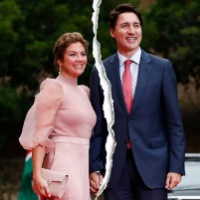
Canadian Prime Minister Justin Trudeau and his wife Sophie are ending their 18-year marriage after having “meaningful and difficult conversations.”
They shared on Instagram that despite the separation, they will continue to be a close family filled with love and respect.
The couple, who tied the knot in Montreal in 2005, have three children together.
While they have signed a separation agreement, Mr. Trudeau’s office mentioned that they will still appear together for public engagements.
“They have worked to ensure that all legal and ethical steps with regards to their decision to separate have been taken, and will continue to do so moving forward,” the statement said, adding they would be on holiday as a family next week.
The couple have asked for privacy for the “well-being” of their children, Xavier, 15, Ella-Grace 14, and Hadrien, nine.
“We remain a close family with deep love and respect for each other and for everything we have built and will continue to build,” Mr Trudeau, 51, and Sophie Grégoire Trudeau, 48, said.
Upon his initial election as prime minister in 2015, the couple featured prominently in a Vogue magazine spread.
In this spread, Sophie Grégoire Trudeau recounted how after their first date, Mr. Trudeau told her, “I’m 31 years old, and I’ve been waiting for you for 31 years.”
In a wedding anniversary post shared on Instagram in May 2022, Ms. Grégoire Trudeau reflected on the challenges inherent in long-term relationships, noting their journey through both sunny days and storms.
Mr. Trudeau has openly acknowledged the difficulties within their marriage. In his 2014 autobiography, he wrote, “Our marriage isn’t perfect, and we have had difficult ups and downs, yet Sophie remains my best friend, my partner, my love. We are honest with each other, even when it hurts.”
The couple’s romantic involvement began in 2003, during Ms. Grégoire Trudeau’s time as a television personality. She is also recognized for her charitable efforts centered around mental health and eating disorders.
Mr. Trudeau becomes the second Canadian prime minister to announce a separation during their time in office.
The first instance was his father, the late Pierre Elliott Trudeau, and mother Margaret Trudeau, who revealed their separation in 1977 after being together for six years. Subsequently, they went on to get divorced.

Federal agents raided the Washington, D.C., home of Democratic Congresswoman Ilhan Omar early Monday morning as part of an ongoing federal criminal investigation, the United States Department of Justice (DOJ) has confirmed.
Homeland Security Investigations agents arrived at the Minnesota congresswoman’s residence at about 6:00 a.m. Eastern Time, according to a report by Fox News.
SEE MORE: Trump Sparks Outrage With Shock Proposal to Rename New Mexico
The report said both the Department of Homeland Security (DHS) and the DOJ are involved in the investigation.
A DOJ spokesperson confirmed the operation, stating: “Today in the Washington, D.C. area, Homeland Security Investigations executed a judicially authorized search warrant secured by the Department of Justice.”
The spokesperson added: “This enforcement action is part of an ongoing federal criminal investigation.”
Details later……….
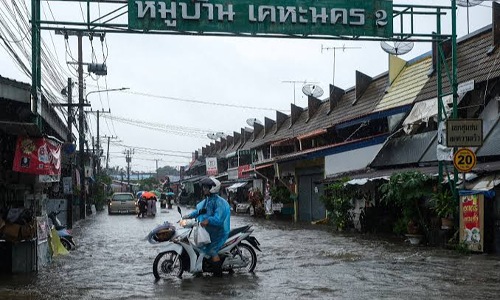
Heavy rains have triggered severe flooding across parts of Bangkok, Thailand, forcing nearly 4,900 residents to evacuate to shelters as floodwaters swept through roads and residential areas.
The flooding has disrupted movement across parts of the Thai capital, with motorists and pedestrians forced to navigate submerged roads and seek alternative routes.
SEE ALSO: NAFDAC Warns Nigerians As Fake Cowbell Milk Floods Market
According to the Bangkok Metropolitan Administration, about 52,000 households have been affected by the flooding, prompting authorities to declare a flood disaster and intensify emergency response efforts.
Emergency teams have been deployed to assist affected communities and move residents from vulnerable areas to safer locations as water levels rise.
Bangkok is accustomed to seasonal heavy rainfall, but intense downpours can overwhelm drainage systems, particularly in low-lying areas, resulting in widespread flooding and disruption.
Authorities are continuing to monitor affected locations while coordinating evacuations and other emergency measures.
For thousands of residents, the immediate priority remains securing safe shelter and protecting homes and livelihoods as authorities work to manage the situation and restore normal activities once the floodwaters recede.
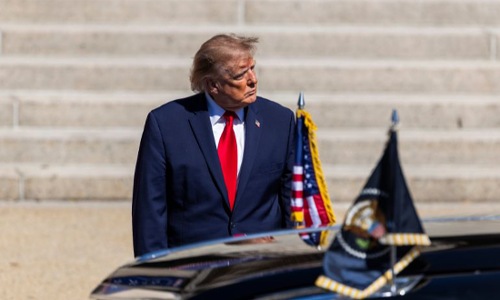
US President Donald Trump has explained his decision to reject Iran’s latest proposal to reopen the Strait of Hormuz, saying Tehran was seeking an agreement because it was losing revenue.
Speaking to reporters at the White House, Trump said Iran wanted to immediately reopen the strategically important waterway but argued that the proposal was not acceptable to his administration.
“They want to make a deal, and I think that’s fine. I like making a deal, too, but that deal would not be acceptable,” Trump said.
SEE ALSO: How the Strait of Hormuz Attack Could Trigger a Fresh Global Oil Shock
According to the US president, Iran’s push to reopen the strait was driven by the economic pressure it was facing.
“What they want to do is immediately open the Hormuz Strait. Do you know why? Because they are dying,” Trump said.
“You know why they’re dying? Because they have no money coming in, because they get their money from the Hormuz Strait.”
Trump also claimed that the US had established an unprecedented naval blockade against Iran, describing it as “a wall of steel.”
“So they outsmarted themselves. We put up the greatest blockade ever in military history. It’s a wall of steel,” he said.
“And guess what? They don’t have any money now because they wanted to close the strait.”
The Strait of Hormuz is a major global energy shipping route, and disruption to traffic through the waterway has significant implications for international oil markets and countries that depend on energy imports.
Trump’s remarks came amid continued tensions between Washington and Tehran over the reopening of the strategic waterway and negotiations involving Iran.






Why Ebola Outbreaks Keep Returning to Africa, Dr Jean Kaseya Explains

Peter Obi Meets UK Officials, Diaspora Stakeholders on Rebuilding Nigeria

Grains-Laden Truck Falls on BRT Lane in Lagos

Ogun Police Chief Urges POWA to Turn Skills Centre into Industrial Hub

Thor Empowers Host Communities with 10 Cassava, Palm Oil Processing Plants

FG Puts Daily Gas Output at 8bcf

Trump’s Family Unveils New Cryptocurrency Platform

Senate Denies Receiving Petitions Against Tinubu’s Ambassadorial Nominees

Dangote Cement Lights Up Benue Host Communities With CSR Initiatives

Reps Recommend 3-year Jail Term For Aviation minister

Tems Sets New Record On Billboard Hot 100 Chart
