
Energy
Sahara Group Shares Three-pronged Net Zero Plan In 2023 Sustainability Report


Strategic investment in gas assets and infrastructure, Integration of Renewable Energy, and Emissions Reduction through Nature-Based Solutions are the tripod strategies poised to drive Sahara Group’s net zero plan going forward.
This was revealed by its Director, Governance and Sustainability, Ejiro Gray, during the launch of the energy conglomerate’s 2023 Sustainability Report, titled, “Dimensioning the Energy Transition: Path to Net Zero”.
According to Gray, the three-pronged strategy reinforces Sahara’s commitment towards a more sustainable future, with 2060 as the net zero target for Sahara’s operations across Africa, Asia, Europe, and the Middle East.
ALSO READ: Aradel Holdings Admitted To NGX’s Main Board, Boosts Market Capitalization By N3.05 Trillion
“This sustainability report underscores our steadfast commitment to addressing environmental, social, and governance (ESG) factors across our diverse operations along the energy value chain. As a business, we showcase a multifaceted strategy to minimise our environmental impact. This includes various initiatives to reduce greenhouse gas emissions, optimise energy efficiency, and responsibly manage resources,” she said.
She noted that the Sahara Group acknowledges the role of natural gas as a crucial bridge fuel and is already expanding investments in gas to ensure energy security while taking tangible steps towards reducing reliance on fossil fuels and contributing to a cleaner energy mix by launching pilot solar projects.
She noted that in pursuit of emissions reduction, Sahara Group embraced nature-based solutions through investments and partnerships in reforestation and conservation projects.
“Our partnership with Treedom exemplifies this commitment, with the planting of 2,000 trees in Cameroon and Kenya expected to absorb a substantial 900,000 tonnes of CO2 over the next decade,” she added.
The Sahara Group’s path to net-zero emissions has been tiered into distinct phases. In the short term (2022-2030), the focus will be on reducing carbon footprint through initiatives like fleet electrification, cycling programs, and energy efficiency measures. In the medium term (2031-2040), Sahara will look to further diversify its energy portfolio and increase investments in renewable energy projects. Ultimately, the goal is to achieve net-zero emissions by 2060 through offsetting any remaining emissions through nature-based solutions and other carbon reduction initiatives.
On his part, Head, Corporate Communications, Sahara Group, Bethel Obioma, pointed out the report’s comprehensive scope, which encompasses various affiliates within the Sahara Group, including Asharami Energy, Sahara Trade, Asharami Synergy, Egbin Power, First Independent Power Limited, Ikeja Electric, and the Sahara Group Foundation.
Obioma said Sahara’s upstream operations recorded reduction in carbon footprint and exceptional host community relations which led to the implementation of impactful projects focused on enhancing livelihoods, education, and healthcare.
“Launching our Gas to Power project, providing 24-hour electricity to the Ajoki Community in Edo State—a first-of-its-kind initiative, achieving ISO 20400 certification for sustainable procurement and recording a remarkable 3 million Lost Time Injury (LTI) free man-hours, underscores our dedication to both social impact and operational safety,” he said.
He said Sahara also achieved successful outcomes from its midstream, downstream, and power businesses through substantial reductions in carbon emissions, focus on operational efficiency, and implementation of renewable energy sources and energy efficiency measures.











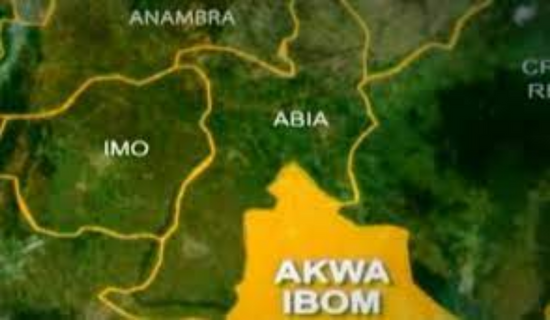
Nearly 20 years after the Federal Government awarded the contract for the 330kV Ikot Abasi Transmission Line, the Niger Delta Power Holding Company Limited (NDPHC) has turned to the Akwa Ibom State Government to break a N4 billion compensation deadlock threatening the completion of the strategic power project.
The transmission project, awarded in 2006 under the National Integrated Power Projects (NIPP), has remained stalled primarily over unresolved community and wayleave compensation issues.
But, to ensure the completion of the project, NDPHC Managing Director/Chief Executive Officer, Jennifer Adighije, is now seeking the intervention of Akwa Ibom State Governor, Pastor Umo Eno, to clear the outstanding issues and enable the contractor, Anit Energy, to return to site.
Adighije made the appeal during a courtesy visit to the Governor in Uyo, Akwa Ibom State.
READ ALSO: Organised Labour Supports Workers’ Demand for N500 PMS Price, N500,000 Minimum Wage
She disclosed that the latest valuation of the outstanding wayleave obligations was slightly below N4 billion.
The NDPHC boss said the prolonged delay was particularly concerning because the contractor had reportedly completed about 90 per cent of the engineering, procurement and construction procurement for the project.
She added that substantial project materials, including conductors and tower members worth millions of dollars, had already been deployed along the project corridor between Adiasim and Ikot Ekpene, but were still lying across communities as the impasse persists.
“We are therefore pleading for your kind intervention as a shareholder and board member of the company,” Adighije told the governor.
According to her, resolving the outstanding community issues would allow the contractor to remobilise to site and bring the long-delayed project to completion.
NDPHC is now targeting May 29, 2027, for commissioning of the transmission line, subject to the successful resolution of the outstanding compensation and community challenges.
Adighije said NDPHC was keen to support the state’s development ambitions through its role as a major interventionist agency in Nigeria’s electricity sector.
“We want to be part of your ARISE Agenda,” she said, referring to the governor’s development programme.
She also welcomed the establishment of the Akwa Ibom State Electricity Regulatory Commission, saying NDPHC had commenced discussions with the commission on the development of appropriate electricity-market frameworks for the state.
According to her, officials of the commission had visited NDPHC and requested information on the company’s projects in Akwa Ibom, while a joint working group was being established to examine how the assets could be better utilised and electricity access extended to underserved communities.
Also speaking, NDPHC Executive Director, Strategy and Commercial, Mr. Patrick Obahiagbon, commended the Governor’s administration for its development initiatives across the state.
Responding, Governor Eno welcomed the NDPHC initiative and pledged to take the Ikot Abasi project before the State Executive Council for consideration. The governor said the state government would examine the outstanding issues and determine how it could intervene to facilitate the completion of the project.
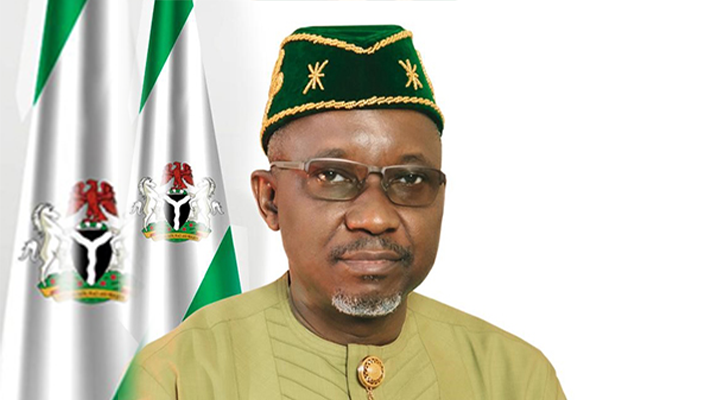
There are indications that the Nigeria-Libya Gas Pipeline would go from the drawing board to reality, as it has emerged as a major option to help Nigeria break into new markets for her gas reserves.
The Minister of State for Petroleum Resources (Gas), Ekperikpe Ekpo, disclosed this at Gastech 2026 in Bangkok, Thailand, during a high-level engagement with global energy companies, investors and governments on expanding Nigeria’s gas production, infrastructure, domestic utilisation and export markets.
The renewed push for the Nigeria-Libya pipeline topped the agenda for the meeting between Ekpo and Libya’s Minister of Oil and Gas, Dr Khalifa Rajab Abdulsadek.
Under the proposed framework, Nigeria and Libya are expected to explore a Memorandum of Understanding (MoU) and establish a joint technical team to assess the feasibility, financing, infrastructure requirements, security considerations and commercial viability of the project.
READ ALSO: ‘Obi Has Nowhere to Hide’ — APC Campaign Council Tackles Peter Obi Over Anambra Record
The NNPC Limited is expected to spearhead Nigeria’s participation in the bilateral initiative. If developed, the pipeline would provide another potential route for transporting Nigerian gas through North Africa to European markets, giving Nigeria an additional platform to monetise its gas resources beyond existing LNG channels.
According to Ekpo, the Federal Government was determined to create an investment environment capable of attracting the capital, technology and strategic partnerships required to convert the country’s gas reserves into economic growth, industrial development and jobs.
“Nigeria is open for business. We have put in place the right fiscal policies and operating environment, and the security of investors and their investments is guaranteed,” he said.
He revealed that the NNPC Limited would play a central role in translating Nigeria’s bilateral energy engagements into commercially viable projects, strategic investments and sustainable development.
The minister’s engagements also revealed plans by major industry players to significantly ramp up domestic gas production and infrastructure.
Gas producers must stop treating methane reduction as an environmental cost, because methane released into the atmosphere represents lost gas, lost revenue and lost energy that could otherwise be recovered and sold.
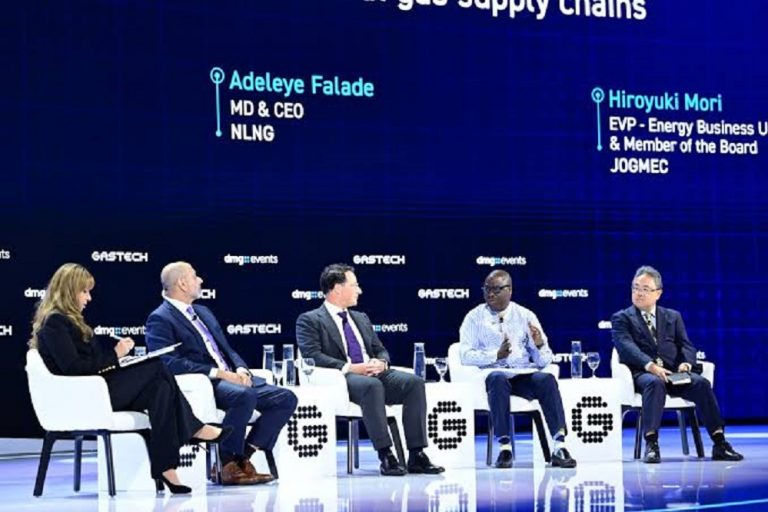
The Managing Director and Chief Executive Officer of Nigeria LNG Limited (NLNG) Adeleye Falade, made the declaration during a panel titled “Capturing the Lost Opportunity: Driving Global Alignment on Methane Abatement Across Natural Gas Supply Chains,” at the Gastech 2026 Exhibition and Conference in Bangkok, Thailand.
READ ALSO: Spike in Petrol Price Moves NLC to Demands Emergency Palliatives
Taking from the company’s experience, he highlighted that investments in methane abatement could pay for themselves while improving plant efficiency and asset reliability.
The NLNG CEO said the commercial value of recovering lost gas should become a central part of the global industry’s approach to methane management.
“Every tonne emitted is lost product, lost revenue and lost energy; gas we could have sold. Every molecule of methane avoided is both an emissions reduction and a recovered energy resource.”
According to him, the NLNG’s new boil-off gas compressor and start-up gas recovery project demonstrate the business case for methane reduction, with each project expected to deliver methane reductions of about 10–15 percent while also recording positive projected net present values. “The most compelling business case is the simplest one: the projects that cut our methane also pay for themselves.
“The same discipline that reduces methane also improves asset reliability and plant efficiency. The returns show up in more places than the emissions ledger,” Falade said.
He added that the starting point for methane abatement was credible measurement of gas losses, which enables companies to identify where methane is being lost, channel investment towards the right interventions and independently verify the results.
According to Falade, the NLNG had demonstrated that producers in developing economies could meet globally recognised standards for emissions measurement and reporting, despite infrastructure and other constraints.
He disclosed that the NLNG had achieved Gold Standard recognition under the Oil and Gas Methane Partnership (OGMP) 2.0 and became the first company in Africa to attain Level 5 methane emissions reporting.
Its measurement, reporting and verification system is independently assured by DNV in line with ISO 14064.
The NLNG’s methane-management programme includes site-wide optical gas imaging, a structured Leak Detection and Repair programme, as well as phased deployment of continuous monitoring and real-time emissions dashboards across its plant and vessels.
Falade said methane reduction was also being incorporated into the design of Train 7, which is expected to raise the NLNG’s LNG production capacity from 22 million tonnes per annum to 30 million tonnes.
The commercial case for emissions abatement was not new to Nigeria, he added, pointing to the NLNG’s longstanding role in converting gas that would otherwise have been flared into a marketable product.
According to him, the company’s activities have contributed to reducing Nigeria’s gas-flaring rate from above 65 percent to below 20 percent.
Beyond its own operations, Falade revealed that the NLNG was extending methane-management requirements across its supply chain through its Scope 3 Advocacy Plan.
The company engages feed-gas suppliers and contractors to measure, disclose and reduce emissions, while verified upstream emissions data and emissions-related criteria are incorporated into supplier selection and evaluation.
Falade also called for greater consistency in methane measurement and reporting requirements across jurisdictions, arguing that divergent standards make enforcement uneven and complicate meaningful comparisons between producers.
“The industry does not need weaker standards; it needs stronger, shared ones backed by real measurement,” he said.
On the tension between emissions reduction, energy access and affordability, Falade said developing economies should not be forced to choose between economic development and climate action.
“Developing economies cannot be asked to choose between economic development and emissions reduction. Both must progress together,” he said.
Other panellists were Zubin Bamji of the World Bank, Niels Dijksman of Brunei LNG and Hiroyuki Mori of JOGMEC.
The session was moderated by energy economist Dr Carole Nakhle of Crystol Energy.






2027: Peter Obi Disowns OK Movement Campaign Council, Says ‘It Is Wrong’

‘Where Is the President?’ — Peter Obi Questions Tinubu’s Prolonged Absence

‘Borrowed Funds Not Spent Cannot Be Counted as Debt Left Behind’ – Peter Obi
NCDMB Woos Chinese Manufacturers

NIPCO Moots $3bn Gas Project with Local Construction

FCT Generates More IGR Than Six North Central States Combined in Three Years

Trump’s Family Unveils New Cryptocurrency Platform

Senate Denies Receiving Petitions Against Tinubu’s Ambassadorial Nominees

Dangote Cement Lights Up Benue Host Communities With CSR Initiatives

Reps Recommend 3-year Jail Term For Aviation minister

Tems Sets New Record On Billboard Hot 100 Chart

459361 47668This design is spectacular! You clearly know how to keep a reader amused. Between your wit and your videos, I was almost moved to start my own weblog (nicely, almostHaHa!) Wonderful job. I genuinely enjoyed what you had to say, and much more than that, how you presented it. Too cool! 652654
532205 187996Do you have a spam issue on this blog; I also am a blogger, and I was wondering your situation; we have developed some nice practices and we are looking to exchange solutions with other folks, be sure to shoot me an email if interested. 628288
353116 646501So may be the green tea i buy in cans exactly the same as the regular tea youd buy to put in your morning cup? Ive been told is just normal green tea produced to be cooler, but does it have any affect as far as not speeding up your metabolism as rapidly as normal hot green tea? 747887
895164 966106Any way Im going to be subscribing for a feed and I hope you post once again soon 460179