
NEWS
SYNLAB Nigeria’s Innovative Push in the Fight Against HIV/AIDS

As Nigeria continues to battle the persistent challenge of HIV/AIDS, social stigma remains one of the most significant obstacles to early detection and effective treatment.
Many Nigerians still avoid screening for fear of judgment, exposure, or discrimination.
While Nigeria has made progress in raising awareness about HIV, stigma and discrimination continue to discourage timely testing.
Many people only get tested after symptoms appear, a delay that worsens health outcomes and increases the risk of spreading the virus.
ALSO READ: From Diagnostics to Discovery: How SYNLAB Nigeria Is Shaping the Future of Medical Research
Recognizing these gaps, SYNLAB Nigeria has introduced a pioneering solution aimed at redefining sexual health testing in the country.
SYNLAB’s response to stigma is Peachy, an anonymous STI testing service designed to give individuals a safe, confidential, and judgment-free pathway to knowing their status.
The initiative leverages privacy and expert-guided support to encourage more people to take responsibility for their sexual health.
“At the heart of Peachy is the belief that no one should be afraid to know their health status,” says the SYNLAB Nigeria team. “Stigma should never stand between anyone and lifesaving information.”
Peachy aims to bridge this stigma gap by providing an environment where individuals can undergo STI and HIV testing without revealing their identities.
The Peachy service offers:
• Anonymity: Individuals can test without disclosing personal details.
• Confidentiality: Results are delivered securely and privately.
• Expert Interpretation: Clients receive professional guidance on next steps.
• Accessibility: Peachy services are available discreetly across Nigeria.
The goal is simple: remove barriers that prevent people from getting tested and empower them to make informed health decisions.
A Portfolio for Every Need
Recognizing that sexual health needs differ from person to person, SYNLAB has developed a suite of Peachy variants tailored to varying levels of testing:
• Peachy On-The-Go: Three STI tests, including HIV
• Peachy: Five STI tests, including HIV
• Peachy Plum: Seven STI tests, including HIV
• Peachy Plum Plus: Ten STI tests
• Peachy Plum Extended: Twelve STI tests
• Peachy Plum Max: Thirteen STI tests
• Peachy Premium (Advanced Panel): High-precision molecular PCR testing
This flexibility ensures that clients can choose the package best suited to their concerns, medical history, or exposure risks.
Impact on HIV/AIDS Prevention and Management
Public health experts emphasize that early detection and consistent follow-up care are central to curbing HIV transmission. Peachy supports this by:
• Promoting Early Detection: Clients are more likely to test when anonymity is guaranteed.
• Protecting Privacy: Reducing the fear of exposure encourages broader participation.
• Supporting Continuity of Care: Expert interpretation guides individuals to appropriate medical care.
• Normalizing Sexual Health Conversations: By making testing routine and stigma-free, Peachy fosters a healthier culture around sexual health.
• Increasing Testing Rates: More people feel safe enough to get screened.
• Reducing Transmission: Early diagnosis allows for timely treatment and reduces the risk of spreading the virus.
SYNLAB Nigeria positions Peachy not just as a test, but as a safe entry point into a broader conversation about sexual health. By prioritizing confidentiality, dignity, and compassion, the initiative is reshaping how Nigerians engage with HIV/AIDS testing.
Conclusion
As Nigeria intensifies efforts to reduce HIV prevalence, innovative approaches like SYNLAB’s Peachy service are crucial. By breaking the culture of silence and fear, SYNLAB is contributing to a future where more people feel empowered to know their status and act on it.
In the fight against HIV/AIDS, Peachy stands out as a reminder that care, privacy, and dignity can make all the difference.
For more information and easy booking, visit the SYNLAB website: www.synlab.com.ng.
About SYNLAB
• SYNLAB Nigeria is a member of the SYNLAB group, with a presence in over 30 countries in four continents.
The organization has over 30 active locations across Nigeria and has been ISO 15189 certified since 2006.
• SYNLAB Group is the leader in medical diagnostic services and specialty testing in Europe.
The Group offers a full range of innovative and reliable medical diagnostics to patients, practicing doctors, hospitals and clinics, governments, and corporations.
• Providing the leading level of service within the industry, SYNLAB is the partner of choice for routine and specialty diagnostics in human and veterinary medicine.
The Group continuously innovates medical diagnostic services for the benefit of patients and customers.
• SYNLAB holds leading positions in most markets, regularly reinforcing the strength of its network through a proven acquisition strategy.
• More information can be found on www.synlab.com, www.synlab.com.ng









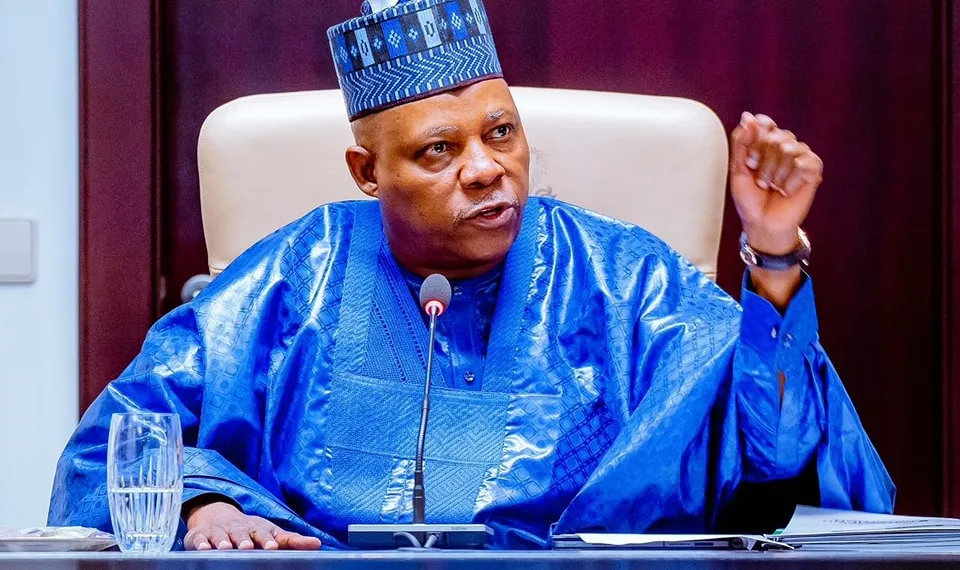
Vice President Kashim Shettima has urged Nigerians to celebrate President Bola Tinubu, saying his leadership saved the country from a potential implosion.
Shettima said Nigeria’s economy had been teetering on the edge of collapse before Tinubu’s intervention, adding that the country could have faced a different situation.
“The economy was teetering on the edge of collapse, we were on a cliff edge,” the Vice President said.
ALSO READ: Subsidy Removal, FX Reforms Driving Fresh Oil Sector Investment – Shettima
“So he literally saved the nation from an implosion. That could have been the scenario. So, instead of demonizing him, Nigerians ought to celebrate this poor man.”
Shettima also called for a return to the drawing board, expressing confidence in the leadership’s commitment and the prospects for the 2027 elections.
“I believe on the bottom of my heart that with this presentation I have seen, and with the commitment of our leadership, by the grace of God, we are going to win,” he said.
Speaking about the 2027 elections, the Vice President reminded his audience that social media platforms should not be mistaken for actual polling stations.
“There are no polling stations on Facebook or Instagram,” he said.
Shettima also expressed gratitude for the efforts made towards promoting the cause of the 2027 elections.


Following observed mis-steps, the Federal Government of Nigeria has withdrawn the eight-count criminal charge brought against the alleged fake Director General (DG) of the Presidential Foreign Intervention Promotion Council (PFIPC), Adeniyi Adeyemi.
Biztellers reports that the matter, in accordance with the counsel of the Attorney General of the Federation (AGF) and Minister of Justice, Prince Lateef Olasunkanmi Fagbemi, (SAN), the matter will be filed at the High Court of the Federal Capital Territory (FCT), instead of the Federal High Court (FHC).
Consequently, upon an unopposed application for termination by the prosecution counsel and Director of the Public Prosecution of the Federation (DPPF), Rotimi Oyedepo (SAN), on Monday, Justice Mohammed Umar of a Federal High Court, Abuja on Monday, struck out the matter.
READ ALSO: Shell Identifies Keys to Nigeria’s Energy Future
In a motion for the termination of the charges, Oyedepo informed the court that the Attorney General of the Federation (AGF) and Minister of Justice has carried out a review of the case file of Adeyemi and the charge filed by the Inspector General of Police (IGP) and found some loopholes.
The DPPF added that the documents allegedly forged by Adeyemi during his operations of the fake agency are those that can be prosecuted by the High Court of the Federal Capital Territory (FCT).
He also informed the court that a new charge has been filed at the High Court of the FCT and that Adeyemi would be expeditiously arraigned afresh.
He therefore urged the judge to strike out the charge as required by law.
Following no objections from Ibrahim Angulu (SAN), who stood in for Adeyemi, Justice Umar subsequently terminated the charge.
Adeniyi, 38, was being tried alongside two others whose whereabouts are unknown, on charges bordering on conspiracy and forgery.
The two others said to be at large were identified as Femi (surname unknown) and Anu (surname unknown).
The charge marked: FHC/ABJ/CR/25/2025, was entered against the defendant by the DPPF.

To secure a bright energy for her teeming population, Nigeria must sustain the momentum of reform, accelerate investment, and deepen partnerships.
This view was expressed by Managing Director, Shell Nigeria Exploration and Production Company of Nigeria Limited (SNEPCo) Ronald Adams in Lagos at the weekend.
Delivering a keynote address at the Africa Energy Conference (AEC) of the Lagos Business School (LBS), Adams called for regulatory certainty through efficient execution of reforms, sustained investment appeal to enable projects to move more swiftly from opportunity to production and partnership by operators, regulators, NNPC Limited and communities to unlock the full value of Nigeria’s resources.
Adams cited Nigeria’s huge oil and gas resources as an advantage but pointed out: “Resources alone do not guarantee prosperity. Prosperity comes when resources are matched with investment, technology, sound policy and disciplined execution. Success will be determined not by the size of our resources, but by our ability to convert them into investment and economic growth.”
Adams pledged the support of Shell towards a bright energy future of Nigerians. He said: “For more than six decades, Shell has been part of Nigeria’s energy journey. Together with our partners, we have helped develop major energy infrastructure, supported Nigerian businesses, invested in talent, and contributed to economic development. Bonga remains a powerful example of what technology, partnership and Nigerian capability can achieve in deepwater operations. Today, that story continues through Bonga North.”
READ ALSO: ADF Targets 5 Million Students, 2 Million Vulnerable Women
Issuing a clarion call for action by all stakeholders, he added: “The world is not standing still. Capital is moving, technology is advancing and competition is intensifying. The countries that attract investment tomorrow are those that improve competitiveness today. Nigeria has begun that journey. Our task is to sustain the momentum and translate reform into projects, projects into growth, and growth into shared prosperity.”
The conference, the 4th in the series had at its theme; “Securing Nigeria’s Energy Future: Policy Reform, Capital Mobilisation, and Pathways to a Sustainable Power and Energy Market” and was attended by top government officials, industry captains, energy professionals, and students.
Lagos State Deputy Governor Obafemi Hamzat represented Lagos State Governor Babajide Sanwo-Olu as the guest of honour. SNEPCo was a principal sponsor of the Africa Energy Conference (AEC) and mounted a well-received exhibition on its deepwater operations and social investments across Nigeria.






Sahara Champions Global Shipping Collaboration for $20m Mercy Ships Healthcare Impact

30 Nigerians Bag Postgraduate Scholarship from NNPC Ltd, Eni

2027: ‘Algorithms Will Not Decide Election Results’, INEC Chairman Declares

Navy Recovers 98,000 Litres of Suspected Stolen Crude in Rivers

DPRP’s Appeal Against Fuel Import Licence Ruling Earns Stakeholder Backing

State Govs, Wike Endorse One-Party State, Join APC Campaign Council

Trump’s Family Unveils New Cryptocurrency Platform

Senate Denies Receiving Petitions Against Tinubu’s Ambassadorial Nominees

Dangote Cement Lights Up Benue Host Communities With CSR Initiatives

Reps Recommend 3-year Jail Term For Aviation minister

Tems Sets New Record On Billboard Hot 100 Chart
