
International News
US State Bans Under-14 Children From Social Media

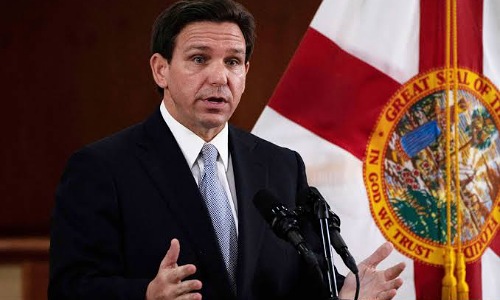
Florida Governor, Ron DeSantis made headlines on Monday by signing into law a groundbreaking bill targeting social media use among minors.
Under the new legislation, children under the age of 14 are barred from accessing social media platforms within the state while those aged 14 or 15 will need parental consent to create accounts.
Dubbed HB3, the law also mandates social media companies to promptly delete accounts held by users under 14 or face potential lawsuits.
Non-compliant companies risk legal repercussions, facing potential lawsuits filed on behalf of underage users who create accounts on their platforms.
As stipulated in the bill, minors could be entitled to receive damages of up to $10,000 for any infractions.
Companies found to be in breach of the law could face substantial penalties of up to $50,000 per violation, in addition to covering attorney’s fees and court costs.
Speaking at the bill-signing ceremony, Governor DeSantis emphasized the legislation’s goal of assisting parents in navigating the complex landscape of raising children in today’s digital age.
Notably, DeSantis had previously vetoed a stricter iteration of the bill, which proposed banning social media accounts for minors under 16 and required Florida residents to provide identification to join social media platforms.
Set to take effect in January 2025, HB3 emerges amidst a growing push for social media regulation nationwide.
Parents’ concerns about the platforms’ insufficient safety measures for children have fueled this momentum.
In December, over 200 organizations rallied behind the Kids Online Safety Act (KOSA), urging Senate Majority Leader Chuck Schumer to fast-track a vote.
KOSA aims to hold apps and online platforms accountable by establishing liability, or a “duty of care,” for content recommendations that could detrimentally impact minors’ mental health.
In January, lawmakers subjected CEOs from TikTok, X, and Meta to rigorous questioning regarding online child safety.
Despite facing scrutiny, the tech executives reiterated their dedication to child safety and highlighted the array of tools they provide as evidence of their proactive approach to combatting online exploitation.
Florida House Speaker Paul Renner and other proponents of the new legislation contend that social media usage poses risks to children’s mental well-being and facilitates communication between minors and sexual predators.
Renner emphasized the importance of active involvement in addressing social media’s impact, stating, “None of us can afford to be on the sidelines when it comes to social media,” during the bill signing.
NetChoice LLC, a coalition representing prominent social media platforms such as Meta, Google, and X, has challenged laws in several states, like Ohio and Arkansas, aimed at restricting teenage social media access.
Similarly, Florida’s legislation is anticipated to encounter legal hurdles, particularly concerning assertions of First Amendment violations.
Carl Szabo, vice president and general counsel for NetChoice, expressed disappointment in Governor DeSantis’s decision to endorse the legislation, labeling it as “unconstitutional” in an email statement.
Szabo emphasized that there are alternative methods to ensure online safety for Floridians and their families without infringing upon their freedoms.
Both Governor DeSantis and Speaker Renner acknowledged the anticipated legal challenges in their remarks.
Renner emphasized the bill’s commitment to upholding the First Amendment, stating, “You will not find a line in this bill that addresses good speech or bad speech because that would violate the First Amendment.
“We’ve not addressed that at all. What we have addressed is the addictive features that are at the heart of why children stay on these platforms for hours and hours on end.”
DeSantis addressed NetChoice directly, asserting, “We’re going to beat them, and we’re never ever going to stop.”
He maintained that the bill is constitutionally sound, emphasizing its adherence to constitutional principles.
DeSantis reaffirmed his commitment to constitutional principles, stating, “Any time I see a bill, if I don’t think it’s constitutional, I veto it.”
He characterized the bill as “a fair application of the law and Constitution,” highlighting its alignment with constitutional standards.









Federal agents raided the Washington, D.C., home of Democratic Congresswoman Ilhan Omar early Monday morning as part of an ongoing federal criminal investigation, the United States Department of Justice (DOJ) has confirmed.
Homeland Security Investigations agents arrived at the Minnesota congresswoman’s residence at about 6:00 a.m. Eastern Time, according to a report by Fox News.
SEE MORE: Trump Sparks Outrage With Shock Proposal to Rename New Mexico
The report said both the Department of Homeland Security (DHS) and the DOJ are involved in the investigation.
A DOJ spokesperson confirmed the operation, stating: “Today in the Washington, D.C. area, Homeland Security Investigations executed a judicially authorized search warrant secured by the Department of Justice.”
The spokesperson added: “This enforcement action is part of an ongoing federal criminal investigation.”
Details later……….
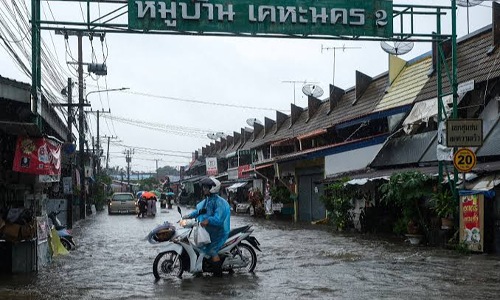
Heavy rains have triggered severe flooding across parts of Bangkok, Thailand, forcing nearly 4,900 residents to evacuate to shelters as floodwaters swept through roads and residential areas.
The flooding has disrupted movement across parts of the Thai capital, with motorists and pedestrians forced to navigate submerged roads and seek alternative routes.
SEE ALSO: NAFDAC Warns Nigerians As Fake Cowbell Milk Floods Market
According to the Bangkok Metropolitan Administration, about 52,000 households have been affected by the flooding, prompting authorities to declare a flood disaster and intensify emergency response efforts.
Emergency teams have been deployed to assist affected communities and move residents from vulnerable areas to safer locations as water levels rise.
Bangkok is accustomed to seasonal heavy rainfall, but intense downpours can overwhelm drainage systems, particularly in low-lying areas, resulting in widespread flooding and disruption.
Authorities are continuing to monitor affected locations while coordinating evacuations and other emergency measures.
For thousands of residents, the immediate priority remains securing safe shelter and protecting homes and livelihoods as authorities work to manage the situation and restore normal activities once the floodwaters recede.
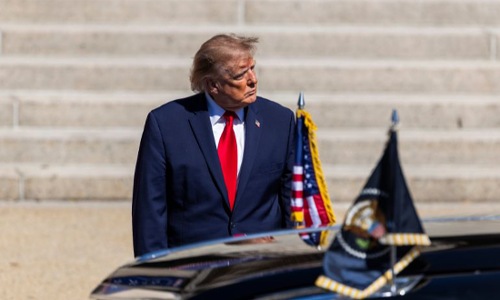
US President Donald Trump has explained his decision to reject Iran’s latest proposal to reopen the Strait of Hormuz, saying Tehran was seeking an agreement because it was losing revenue.
Speaking to reporters at the White House, Trump said Iran wanted to immediately reopen the strategically important waterway but argued that the proposal was not acceptable to his administration.
“They want to make a deal, and I think that’s fine. I like making a deal, too, but that deal would not be acceptable,” Trump said.
SEE ALSO: How the Strait of Hormuz Attack Could Trigger a Fresh Global Oil Shock
According to the US president, Iran’s push to reopen the strait was driven by the economic pressure it was facing.
“What they want to do is immediately open the Hormuz Strait. Do you know why? Because they are dying,” Trump said.
“You know why they’re dying? Because they have no money coming in, because they get their money from the Hormuz Strait.”
Trump also claimed that the US had established an unprecedented naval blockade against Iran, describing it as “a wall of steel.”
“So they outsmarted themselves. We put up the greatest blockade ever in military history. It’s a wall of steel,” he said.
“And guess what? They don’t have any money now because they wanted to close the strait.”
The Strait of Hormuz is a major global energy shipping route, and disruption to traffic through the waterway has significant implications for international oil markets and countries that depend on energy imports.
Trump’s remarks came amid continued tensions between Washington and Tehran over the reopening of the strategic waterway and negotiations involving Iran.






FG Puts Daily Gas Output at 8bcf

With Crude at $111, IEA Sees Prolonged Crisis

NCDMB Joins Hand with Manufacturers to Boost Local Oil, Gas Components Production

Dangote Preaches Ambition, Africa First to Nigerian Creatives

Protest Against Oil Company’s Vessel in Rivers Takes 10 Lives

FRSC Warns Drivers After Brake Failure Kills Two in Kano Crash

Trump’s Family Unveils New Cryptocurrency Platform

Senate Denies Receiving Petitions Against Tinubu’s Ambassadorial Nominees

Dangote Cement Lights Up Benue Host Communities With CSR Initiatives

Reps Recommend 3-year Jail Term For Aviation minister

Tems Sets New Record On Billboard Hot 100 Chart
