
Business
Awards Nite: Dangote Splashes N11bn in Gifts, Cash on Cement Distributors, Customers


For their continued loyalty and patronage, Dangote Cement Plc has rewarded its distributors and customers with various choice gift items and cash worth N11 billion.
This transpired at the 2025 edition of its Customers Awards & Gala Nite held in Lagos, a premium celebration dedicated to recognising and rewarding its highest-performing distributors, with the theme ‘Let’s Acceler8′, the cement giant rewarded its distributors with gift items comprising several CNG trucks, containers filled with products, and cash valued at over N11 billion.
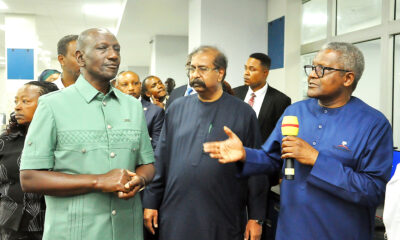
Welcoming customers of the company to the distributors’ award ceremony, Chairman of Dangote Cement / President of Dangote Industries Limited, Aliko Dangote, commended the distributors for their unwavering commitment and resilience “in driving our business forward, even amidst economic challenges.”
He lauded “their perseverance and determination in ensuring our products remain available in the market. Thanks to your efforts, we have secured over 57 per cent of the market share, and we encourage you to continue pushing for more growth.”
Dangote noted that “this year’s theme serves as a rallying call for unity and collective growth as we strive for unmatched market leadership in 2025. This theme reflects the strength of our partnership with valued customers, which continues to drive the success of Dangote Cement.”
He also noted that “Our leadership in the building and construction sector is rooted in this mutually beneficial relationship. Also, the partnership has been instrumental in elevating us to the position of Africa’s largest cement producer.”
He said, “in appreciation of the hard work, unflinching loyalty, and commitment of our esteemed customers in the year 2024, we are rewarding you with gift items and cash valued at over N11 billion. We are also celebrating our valued corporate customers, who have consistently chosen our cement products for a wide array of construction projects.”
He assured the stakeholders of the Company’s commitment to research and continuous improvement in its production processes and the highest quality products.
In his welcome address, Group Managing Director of Dangote Cement Plc, Arvind Pathak, stated, “Tonight, we celebrate the pivotal role our customers play in ensuring the widespread availability of our products across every region of Nigeria. We recognise and appreciate your remarkable efforts in driving the sales, distribution, and usage of our products throughout the year 2024.”
He said, “The outstanding performance of our company, especially in the past year, is a testament to your collective commitment and resilience. We are thankful for your continued dedication, which has made our products visible across all geopolitical regions. As vital partners in our value chain, from quarry to customer, your role is instrumental.
“To support your growth, we have distributed over 5,000 containers to various retailers. This initiative not only enhances our business value but also ensures that consumers receive products with an extended shelf life directly from the factory. In alignment with our chairman’s vision, we aim to distribute an additional 4,000 containers to our customers and retailers this year.”
Pathak added, “In line with DCP’s commitment to sustainability and the country’s clean fuel policy, we are transitioning our fleet of over 7,000 trucks from AGO to CNG by the end of 2026.
“We are making significant investments in new CNG trucks and the necessary infrastructure to support this transition. Currently, 3,100 trucks are operational, and our initiatives in alternative fuel utilisation have gained global recognition, with Dangote Cement receiving a commendable score from CDP in climate change and water security.”
He pointed out that “we are excited to reward some of our customers who have shown outstanding performance with CNG trucks to further develop their businesses. These rewards demonstrate our dedication to supporting our customers’ growth and commitment to sustainability. We are focused on strengthening the partnerships that have positioned us as the leading civil manufacturer in the nation.”
The Group Executive Director of Commercial Operations at Dangote Industries Limited, Fatima Aliko Dangote, acknowledged the significant contributions of the distributors. She emphasised the importance of their outstanding performance and achievements to the company’s sales growth and market expansion in 2024.
She noted that their efforts play a crucial role in sustaining public awareness and developing a market for Dangote’s cement products.
Aliko Dangote identified and highlighted the distributors as the backbone of the company’s growth and success, and encouraged them to aim for even higher performance levels in 2025.
The awards categories were in phases; Regional Award, Growth Award, Best Performing Customers.






Emeritus Professor of Economics, Akpan Ekpo, has said Nigeria needs to achieve and sustain double-digit economic growth for between 15 and 20 years to make a significant impact on poverty.
Ekpo made the submission while reacting to the latest World Bank assessment of Nigeria’s economic outlook, which raised the country’s 2026 growth forecast to 4.3 per cent.
ALSO READ: Obi Asks World Bank, Banks to Verify Anambra Debt Claims
Recall that the World Bank, in its October 2026 Africa Economic Update, projected that Nigeria’s economy would grow by 4.3 per cent in 2026, up from an estimated 4.0 per cent in 2025, before rising to 4.4 per cent annually in 2027 and 2028.
The lender attributed the improved outlook to improving macroeconomic stability, stronger investor confidence and a gradual recovery in private investment.
However, Ekpo cautioned against celebrating single-digit growth, arguing that economic growth alone does not amount to development.
“I don’t think we should celebrate the 4.1% growth. The World Bank itself knows that growth is not development,” Ekpo said.
According to the economist, Nigeria needs to grow at least 10 per cent annually and sustain such expansion for about 15 to 20 years to make a meaningful dent in poverty.
“You have to grow at least double-digit, sustained for about 15–20 years to have a dent on poverty,” he said.
‘4% Growth Is Too Weak’
Ekpo said even the World Bank’s assessment indicates that the current pace of growth remains insufficient to create the jobs and opportunities Nigeria needs.
He noted that the World Bank had identified electricity, reliable internet access, infrastructure and human capital development among the areas requiring attention.
“But the problem is that the 4.1% growth cannot achieve those things,” he said.
The World Bank has similarly stressed that stronger growth must translate into better living standards, productive jobs and poverty reduction, with investment in infrastructure, human capital and productivity needed to sustain the gains.
Ekpo said Nigeria therefore needs to move beyond celebrating modest improvements in GDP and focus on achieving structural economic transformation.
Ekpo Faults Manufacturing Contribution
The economist also criticised the structure of Nigeria’s economy, particularly the limited contribution of manufacturing.
According to him, Nigeria’s economic transformation should involve movement from agriculture and mining into industry and manufacturing before services become dominant.
“They left out the issue of manufacturing, that is where the crux of the matter is,” he said.
Ekpo argued that manufacturing should contribute at least 40 per cent of Nigeria’s GDP for the economy to undergo meaningful structural transformation.
“An economy has—the structure has to be transformed where that sector called manufacturing contributes at least 40% to GDP,” he said.
He claimed that manufacturing had contributed less than 12 per cent to Nigeria’s GDP over the past 60 years.
The economist also pointed to Nigeria’s trade structure, saying manufactured exports account for about two per cent of total exports, while manufactured imports account for about 48 per cent.
“So you cannot say with that that the economy has been transformed,” he said.
Ekpo Questions Macroeconomic Stability
Ekpo also questioned the description of Nigeria’s economy as enjoying broad macroeconomic stability.
He acknowledged improvements on the monetary side but said significant challenges remained on the fiscal side.
“On the monetary side, yes, the CBN has restored some integrity in that sub-sector. But on the fiscal side, we still have challenges,” he said.
He argued that economic stability should also be assessed from the perspective of households and businesses, which collectively form the broader economy.
“You can’t have stability on only one side of the economy, that is relative stability, and say the economy is stable,” Ekpo said.
‘It Is a Warning Signal’
While describing the World Bank report as balanced, Ekpo said it should be treated as a warning to policymakers rather than a reason for celebration.
“The report, in my view, is balanced. I’m not a World Bank fan, but it’s balanced because they raised fundamental issues that those who manage the economy, we have to do for us to make progress,” he said.
He maintained that although growth is necessary for development, growth alone does not guarantee development.
“Yes, you need to grow to develop, but you can grow and not be developed. And that growth must be double-digit, 10% and above, and sustained for about 15 or 20 years,” Ekpo said.
He called for deliberate government action to fix electricity, tackle insecurity and reduce poverty, while also warning that persistent double-digit inflation remains a challenge.
“I don’t think the report is what we should celebrate, but it’s a warning signal that we should do more,” he said.
“Inflation is still double-digit, so the report has to be treated cautiously.”
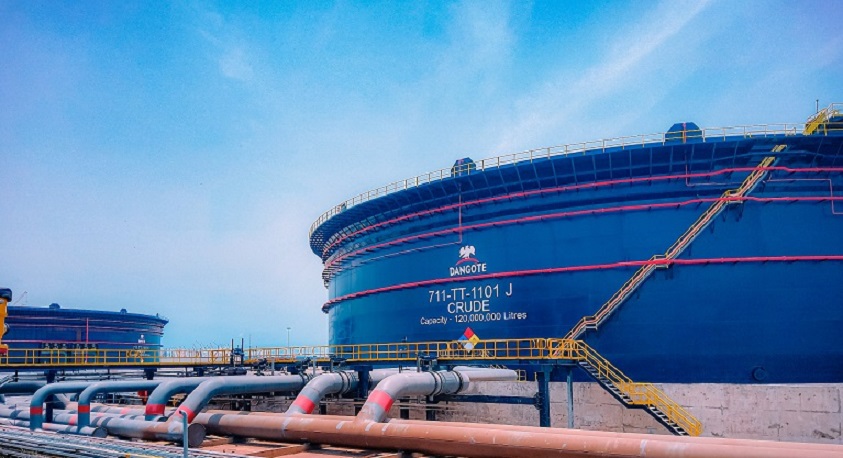
The Aliko Dangote Foundation (ADF) has unveiled the Women’s Share Subscription Grant Initiative (WSSGI), a pioneering financial inclusion programme aimed at increasing women’s participation in Nigeria’s capital market through the ongoing Initial Public Offering (IPO) of Dangote Petroleum Refinery and Petrochemicals FZE (DPRP).
The nationwide initiative is designed to support up to two million Nigerian women, with a special focus on low- and middle-income earners, as well as vulnerable women. Through the programme, ADF seeks to expand access to equity ownership, promote a culture of savings and long-term investing, and empower women with greater opportunities for wealth creation through responsible participation in the capital market.
The initiative is open to several categories of beneficiaries, including independent applicants earning ₦100,000 or less per month, verified participants in designated ADF programmes such as CRoWN, ADFIN, and Mu Shuka Iri, eligible non-commissioned servicewomen and service spouses, as well as verified service widows.
To accommodate different categories of participants, the initiative provides two pathways for entry: Matching Grant Track: Eligible independent applicants who subscribe to a minimum of 10 shares will receive an ADF-funded application for an additional 10 shares in their name.
Unconditional Grant Track
The ADF will fund an application for 20 shares on behalf of eligible beneficiaries who satisfy programme eligibility, investor identification, and Know Your Customer (KYC) requirements.
This category covers verified beneficiaries from designated ADF programmes and verified service widows.
Under both tracks, grant funds will be applied directly through the designated issuing house. No cash payments will be made to beneficiaries, government agencies, or sponsors. Any shares successfully allotted will be credited solely to the beneficiary and held in her name.
Eligibility Requirements
Applicants must be Nigerian women aged 18 years and above; resident in Nigeria; meet the eligibility requirements of their respective participation category; successfully complete all required identity verification and KYC processes; and receive no more than one ADF share grant across all Foundation share grant schemes.
The ADF is implementing the initiative in partnership with Vetiva Capital Management and the Nigerian Exchange Group (NGX) through the Securities and Exchange Commission (SEC)-approved IPO subscription infrastructure.
The Foundation will not receive, collect, or hold applicants’ or sponsors’ subscription funds. All applications, payments, allotments, and refunds will be handled in accordance with the IPO Prospectus, applicable regulatory requirements, and the approved basis of allotment.
Participation in the programme is entirely voluntary. Prospective investors should note that share prices may fluctuate, dividends are only payable when declared, and neither allotment nor investment returns are guaranteed.
To facilitate broad participation, applicants are not required to have an existing Central Securities Clearing System (CSCS) account. Where necessary, accounts will be created through Vetiva upon successful completion of the IPO’s KYC requirements.
Eligible independent applicants may submit their applications exclusively through the official ADF portal at ipo.alikodangotefoundation.org.
READ ALSO: 40 Oil Blocks up for Grabs as NUPRC Opens 2026 Bid Round
Beneficiaries affiliated with the ADF programmes and verified service widows will receive application guidance through approved Foundation channels.
The offer closes on 13 October 2026.
The ADF urges prospective participants to remain vigilant against fraud. Applicants should not make payments to agents, individuals, or personal bank accounts in exchange for grants or promises of guaranteed allotment. Passwords, PINs, and one-time passwords (OTPs) should never be shared, and any unexpected payment request or online link should be verified through official channels before action is taken.
Through this initiative, the ADF is reinforcing its commitment to inclusive economic empowerment, broadening access to investment opportunities, and enabling more Nigerian women to participate meaningfully in the nation’s wealth creation journey.

The Nigerian Upstream Petroleum Regulatory Commission (NUPRC) has unveiled a pipeline of major offshore projects with the potential to attract significant new investment into Nigeria’s upstream petroleum sector.
This is as the commission has intensified efforts to convert the country’s substantial hydrocarbon resources into producing assets and sustainable economic value, the NUPRC said in a statement.
According to the statement, Nigeria’s upstream investment outlook was presented at the Nigeria Investment Forum 2026 in New York by the Commission Chief Executive (CCE), Oritsemeyiwa Eyesan.
Eyesan, who was represented by the Executive Commissioner, Corporate Services and Administration, Dr. Kelechi Ofoegbu, highlighted the emerging investment opportunities across Nigeria’s offshore, gas and brownfield assets, noting that the combination of regulatory reforms, improved project economics and a growing pipeline of development-ready assets is creating new opportunities for investors and industry partners.
READ ALSO: NCDMB, Zeconia Global Train 50 on Digital Oilfield Operations
A key feature of the presentation, it said, was the identification of 22 major offshore projects, comprising 12 deepwater and 10 shallow-water developments, as part of the pipeline capable of driving substantial new capital into the sector.
According to the commission, the projects include major developments such as Bonga Southwest, Aparo, Zaba Zaba, Owowo, Bosi and Egina South.
The NUPRC also highlighted recent capital commitments across projects including Bonga North, Obeta Gas Development, HIN Associated Gas Development and Iseni Gas Development, demonstrating the movement of investment interest towards actual project development.





World Bank Report: ‘Nigeria Needs 10% Growth for 20 Years to Reduce Poverty’ — Ekpo
Yenagoa Hosts NCDMB 2026 Content Forum

IPO: ADF Opens Wealth Creation Pathway for 2m Vulnerable Nigerian Women

2027: Tinubu Will Beat Atiku, Obi by Wide Margin, Says Bwala

‘Dem Dey Use Stick Dey Flog Women’ — Nigerians in India Camp Cry Out

2027: I’ll Bring Petrol Price Down to ₦300, Says Donald Duke

Trump’s Family Unveils New Cryptocurrency Platform

Senate Denies Receiving Petitions Against Tinubu’s Ambassadorial Nominees

Dangote Cement Lights Up Benue Host Communities With CSR Initiatives

Reps Recommend 3-year Jail Term For Aviation minister

Tems Sets New Record On Billboard Hot 100 Chart

Enjoyed examining this, very good stuff, thankyou. “Be not careless in deeds, nor confused in words, nor rambling in thought.” by Marcus Aurelius Antoninus.
uhtn8a
I have been absent for a while, but now I remember why I used to love this site. Thank you, I?¦ll try and check back more often. How frequently you update your website?
Este site é realmente fantástico. Sempre que acesso eu encontro coisas incríveis Você também vai querer acessar o nosso site e descobrir mais detalhes! conteúdo único. Venha saber mais agora! 🙂
My spouse and i felt absolutely relieved when Chris could round up his preliminary research while using the precious recommendations he obtained from your site. It’s not at all simplistic to just choose to be giving freely helpful tips a number of people might have been selling. And we also already know we have got the blog owner to give thanks to for that. The type of illustrations you’ve made, the easy site navigation, the friendships you can give support to instill – it is everything powerful, and it is assisting our son and us imagine that that situation is cool, which is certainly rather serious. Thank you for all the pieces!
Hi there! I know this is somewhat off topic but I was wondering which blog platform are you using for this website? I’m getting tired of WordPress because I’ve had issues with hackers and I’m looking at alternatives for another platform. I would be awesome if you could point me in the direction of a good platform.
Hiya, I’m really glad I have found this information. Today bloggers publish just about gossips and internet and this is actually annoying. A good website with exciting content, that’s what I need. Thanks for keeping this web site, I’ll be visiting it. Do you do newsletters? Cant find it.
I cling on to listening to the news speak about receiving boundless online grant applications so I have been looking around for the finest site to get one. Could you advise me please, where could i get some?
Thanks for the sensible critique. Me and my neighbor were just preparing to do a little research about this. We got a grab a book from our local library but I think I learned more from this post. I am very glad to see such wonderful info being shared freely out there.
Great website! I am loving it!! Will be back later to read some more. I am bookmarking your feeds also.
Thanks a lot for sharing this with all of us you actually know what you are talking about! Bookmarked. Please also visit my website =). We could have a link exchange agreement between us!
I haven’t checked in here for some time since I thought it was getting boring, but the last few posts are good quality so I guess I will add you back to my daily bloglist. You deserve it my friend 🙂
great post, very informative. I wonder why the other experts of this sector don’t notice this. You should continue your writing. I’m confident, you have a great readers’ base already!
I like the helpful info you provide in your articles. I’ll bookmark your blog and check again here frequently. I’m quite certain I’ll learn a lot of new stuff right here! Best of luck for the next!
What i don’t understood is if truth be told how you are now not really a lot more neatly-favored than you may be now. You’re so intelligent. You already know thus considerably with regards to this subject, made me individually consider it from so many varied angles. Its like men and women don’t seem to be fascinated until it’s something to do with Girl gaga! Your personal stuffs excellent. Always deal with it up!
Someone essentially help to make seriously articles I would state. This is the first time I frequented your web page and thus far? I amazed with the research you made to create this particular publish incredible. Wonderful job!
I simply couldn’t depart your web site prior to suggesting that I actually enjoyed the standard info a person supply in your guests? Is going to be back often to check up on new posts
A large percentage of of the things you mention happens to be astonishingly precise and it makes me ponder the reason why I had not looked at this with this light previously. This piece really did turn the light on for me personally as far as this particular subject matter goes. Nevertheless there is one factor I am not necessarily too comfy with and while I try to reconcile that with the central idea of your point, permit me see what the rest of your subscribers have to point out.Very well done.
Good web site! I truly love how it is easy on my eyes and the data are well written. I am wondering how I might be notified when a new post has been made. I’ve subscribed to your feed which must do the trick! Have a great day!
It’s laborious to seek out educated individuals on this matter, however you sound like you realize what you’re talking about! Thanks
Just about all of whatever you articulate happens to be supprisingly appropriate and it makes me ponder why I hadn’t looked at this with this light previously. This piece truly did switch the light on for me personally as far as this specific topic goes. However there is actually 1 point I am not really too cozy with and whilst I try to reconcile that with the actual main theme of the position, allow me observe exactly what the rest of the visitors have to say.Very well done.
Your place is valueble for me. Thanks!…