
Education
How ASUU May Forfeit 8 Months Pensionable Period – Chris Ngige


The Federal Government has indicated that members of the Academic Staff Union of Universities, ASUU, may also forfeit their eight months of pension benefits for the time the strike lasted, so the controversy roiling the Nigerian university system may not be over just yet.
Chris Ngige, the minister of labour and employment, made this statement in Abuja following a private meeting with President Muhammadu Buhari at the presidential villa.
Ngige who described the year 2022 as a year of strikes, noted that members of ASUU triggered the fate which might befall them as a result of the “no work no pay policy” implemented while their strike lasted.
Recall that the apex university union terminated its eight-month strike but did not receive its full month’s salary as a result, leading to an argument between ASUU and the federal government.
Ngige bemoaned the situation, saying that in contrast to the private sector, which was generally quiet throughout the year, the government had to deal with labor issues from numerous unions in the public sector.
The minister of labor also suggested that financial issues were a hindrance to government, but he also mentioned that preparations are in the works to support academic staff’ salaries.
The minister said: “ASUU has not pronounced anything on their salary anymore because it’s one of the issues that was referred to the National Industrial Court for determination, whether a worker who is on strike should be paid in violation of Section 43 of the Trade Dispute Act which says when you go on strike, the consequences are these.
“Number one, you will not be paid, you will not be compensated for not going to work to enable your employer keep the industry or enterprise afloat. That money should not be given to you, and that compensation should not be given. It’s there in Section 43 (1). There is a second leg for Section 43, it also said that period you were on strike will not count for you as part of your pensionable period of work in your service.
“That aspect, government has not touched it, but the aspect of no-work-no-pay has been triggered off by that strike. So we are asking the court to look at it. So the matter is out of the hand of the Executive (that’s us) and out of the hand of the judiciary. ASUU has also put up a defence in court, asking the court, “yes we went on strike, but we did that for a reason.” So it’s now left for the court to look at it.”
Commenting on his mission to the presidential villa, Ngige said, he was there to brief Mr President on the labour sector for 2022.
“It’s a year we can call a year of industrial dispute starting from the February Academic Staff Union of the Universities (ASUU) strike which was joined by other sister unions in the university system and even the people in the research institutes and thereafter pressed from various unions, including the Medical Doctors Association and the youth wing of the National Association of Resident Doctors.
“JOHESU which is the Joint Health Sector Union were all asking for a wage increase, and asking for a wage increase can also be understandable because of what inflation had done to the economy and the attendance cost of living for people who have to be workers in the public sector.
“In the private sector, the private sector employers have managed their affairs better, maybe, because their finances and its management is within their very audit and they could control it, they could do collective bargaining very easily with their workers. The banking sector, food and beverages, and finance, insurance, everywhere; there is calm there. We didn’t have the desired calmness on the government’s side because of the government’s finances, “Ngige told State House correspondents.







The National Association of Nigerian Students (NANS) has warned university managements against using the availability of the Nigerian Education Loan Fund (NELFUND) as a justification for arbitrary increases in tuition fees.
The association urged universities across the country to explore alternative revenue-generating opportunities rather than impose additional financial burdens on students already grappling with Nigeria’s harsh economic realities.
NANS made its position known in a press release dated Sunday, October 18, 2026, signed by its President, Dist. Comr. Akinteye Babatunde Afeez, GCNS.
RELATED NEWS: NANS Threatens to Shut Down AE-FUNAI Over School Fees Hike
The student body maintained that although universities require adequate funding, students should not be made to bear the financial challenges confronting their institutions.
“To be clear, education cannot be commercialised. Students cannot be made to pay for the financial challenges confronting our universities,” the statement read.
According to the association, the Federal Government is investing heavily in education to keep students in school and ensure that access to education remains available to Nigerians regardless of their backgrounds and financial status.
NANS argued that university administrators, particularly vice-chancellors, must think outside the box and develop innovative ways of generating revenue without placing additional financial pressure on students.
NANS Cautions Universities Over NELFUND
The association said the establishment of NELFUND was part of the Federal Government’s efforts to expand access to education, but warned that university managements must not interpret the initiative as an opportunity to increase tuition fees arbitrarily.
“University managements must therefore refrain from increasing tuition fees arbitrarily on the assumption that NELFUND is available to pay students’ tuition,” the statement said.
NANS insisted that the student loan scheme should not become a reason for universities to impose higher charges on students, adding that managements must seek other sources of revenue that would not stretch students beyond their financial limits.
The association maintained that universities could pursue additional funding without transferring the burden of their financial challenges to students.
It also called on university administrators to adopt innovative approaches to revenue generation while ensuring that students are not subjected to unnecessary and unbearable financial demands.
NANS Calls for Alternative Funding Strategies
The student association emphasised the need for university managements to develop sustainable funding strategies that would support their operations without undermining students’ access to education.
It argued that increasing tuition fees could frustrate the academic aspirations of students, particularly those struggling to cope with the country’s economic difficulties.
NANS reiterated that the interests, welfare and aspirations of Nigerian students must remain a priority in decisions affecting university education.
The association pledged to continue speaking firmly against policies that place unnecessary financial burdens on students.
It maintained that the availability of government-backed education loans should complement efforts to make education accessible rather than serve as a justification for arbitrary tuition increases.


The Nigerian Content Development and Monitoring Board (NCDMB), in partnership with Techico Resource Solutions Limited, has provided educational materials and teaching tools to Ugbuwangue Secondary School in Warri, Delta State.
The intervention was formally handed over to the school on Tuesday, September 22, 2026, at a ceremony attended by representatives of NCDMB, Techico Resource Solutions Limited, the school leadership, teachers, students, and members of the Ugbuwangue community.
READ ALSO: NCDMB Woos Chinese Manufacturers
A statement from the partners on Thursday has it that the support was provided under the “Back to the Creeks” initiative, which was designed to address practical challenges facing students and teachers by providing resources to improve the learning environment and support more effective teaching and learning.
Speaking at the ceremony, Chief Executive Officer of Techico Resource Solutions Limited, Omolola Bolushire, expressed appreciation to NCDMB for supporting the vision behind Back to the Creeks and investing in the future of young people.
She said the initiative demonstrated the importance of moving beyond conversations about development to taking practical steps that respond to the needs of communities.
“It is easy to talk about development. It is something else entirely to come into a community, listen, identify real needs and commit resources to making a difference,” Bolushire said.
Bolushire urged the school and Ugbuwangue community to take ownership of the intervention and protect the resources provided so that future generations could continue to benefit from them.
“These are not simply gifts to a community. They are an investment in a community. Please protect the facilities, protect the school and protect what has been provided,” she said.
Representing NCDMB, Mrs Khadija Jekine, who represented the Executive Secretary, said the Board was pleased to support an initiative focused on improving the learning experience of young people.
“Education is an investment in the future. By supporting schools and young people, we are helping to create opportunities that can have a lasting impact on communities,” Jekine said.
The Principal of Ugbuwangue Secondary School, Mrs Morrison Jemiyotan, also expressed appreciation for the intervention, noting that the resources would support both teachers and students.
“We are grateful for this support. These materials will make a meaningful difference to our school, and we are committed to ensuring that they are properly used and maintained for the benefit of our students,” the Principal said.
The Back to the Creeks initiative reflects the shared commitment of NCDMB and Techico Resource Solutions Limited to supporting communities and creating opportunities for young people through education.
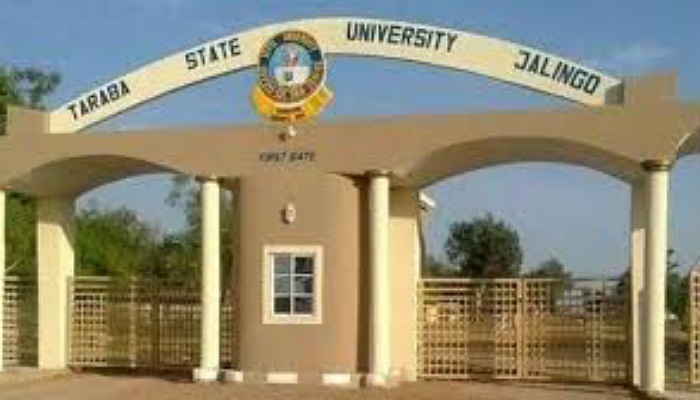
As the indefinite strike at Taraba State University (TSU) continues, both students and lecturers have been caught in a standoff over unresolved issues between the state government, the University’s management, and the Academic Staff Union of Universities (ASUU).
The strike, which has led to the suspension of exams and left the campus in disarray, stems from long-standing disputes regarding the welfare of lecturers and critical institutional concerns.
Students at TSU, Jalingo, are facing growing uncertainty as the academic calendar remains halted amid the ongoing crisis.
READ MORE: Journalist Adedayo Oderinu Advises Women Against Having Many Children
The Chairperson of ASUU-TSU, Dr. Garba Joshua, disclosed that the strike commenced after a 30-day grace period lapsed without meaningful action from the state government and university authorities to address key demands.
“The unresolved grievances include the lack of a pension scheme, non-payment of salary arrears, failure to constitute a Governing Council, non-payment of Earned Academic Allowances, exclusion from minimum wage implementation, and inadequate funding as stipulated by the University’s founding law,” Dr. Joshua explained.
He added, “ASUU-TSU has consistently engaged with the government to resolve these pressing issues. However, the lack of commitment and action has left us with no choice but to take this step in defense of our members’ welfare, the integrity of the institution, and the future of higher education in Taraba State.”
The strike has left students in limbo, with many expressing frustration over their interrupted academic progress. Some were seen leaving campus with no indication of when classes or exams would resume.
One student, speaking on the condition of anonymity, said, “We are the ones paying the price for a crisis we didn’t create. It’s disheartening to see our education put on hold because of these unresolved issues.”
The impasse has sparked concern among parents and education stakeholders, who are calling for urgent intervention to resolve the crisis.
However, as of the latest update, no resolution has been reached, leaving the future of academic activities at TSU uncertain.
Students and lecturers alike are now waiting for the state government and university management to take decisive action to end the strike and restore normalcy to the institution.





Tragedy Hits Spanish Football As Tenerife Striker Jesus De Miguel Dies At 30

NUPRC Dangles 40 Oil Blocks Before Global Investors at ADIPEC

OPEC+ Retains Output at 30.9mbpd

Gas Infrastructure Fund Sets Terms for Indigenous Access to Funding

UN Engages NCDMB to Deepen Female Access to $40m Oil, Gas Fund

Shettima Arrives Calabar for APC Presidential Campaign Rally

Trump’s Family Unveils New Cryptocurrency Platform

Senate Denies Receiving Petitions Against Tinubu’s Ambassadorial Nominees

Dangote Cement Lights Up Benue Host Communities With CSR Initiatives

Reps Recommend 3-year Jail Term For Aviation minister

Tems Sets New Record On Billboard Hot 100 Chart
