
International News
Israeli-Palestinian Confrontation Enters Third Day, Escalation Persists

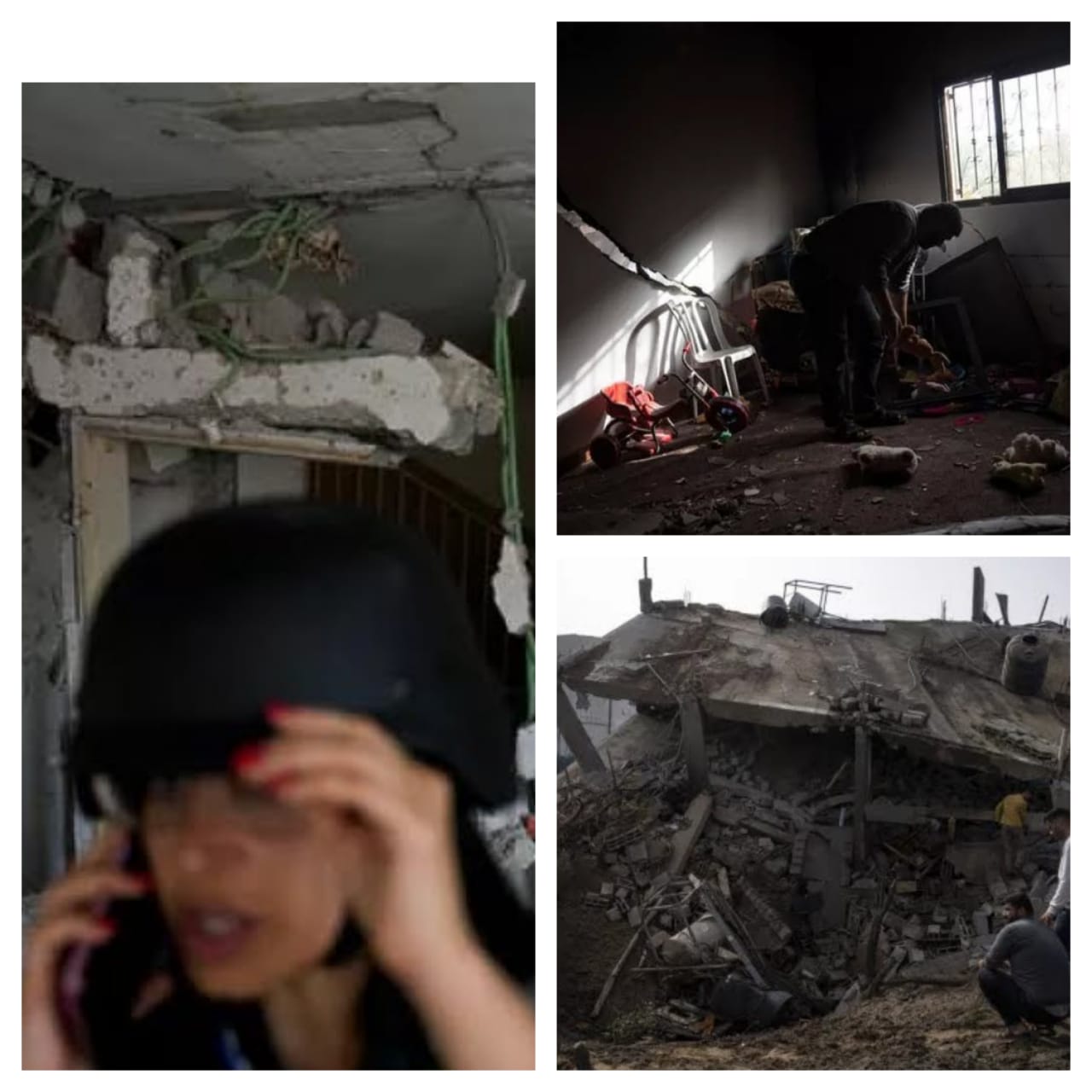
In a protracted escalation of violence, Israel and Palestinian militants have engaged in their most intense confrontation in months, extending into a third consecutive day.
Israeli airstrikes have targeted locations in the Gaza Strip, while militants have responded by launching rockets towards Jerusalem and southern Israel.
As of Friday, there have been no immediate reports of casualties on either side. International mediators have been actively involved in pursuing a ceasefire to quell the ongoing hostilities.
The recent clashes have resulted in the loss of 31 Palestinian lives in Gaza, alongside the death of a 70-year-old individual in central Israel. The situation remains highly volatile as both sides grapple with the consequences of the conflict.
Hopes for a possible ceasefire in the Israel-Palestinian conflict were briefly dashed when a series of rockets were fired from the Gaza Strip, triggering warning sirens near Jerusalem.
The rockets broke a 12-hour period of calm, during which Egypt, Qatar, and the United Nations had been working towards a potential truce between the two sides.
Residents of Israeli settlements near Jerusalem were alarmed as explosions rocked the area, accompanied by billowing black smoke, following what appeared to be the interception of a missile.
One rocket struck an open field in the Bat Ayin settlement in southern Jerusalem, as confirmed by Josh Hasten, a spokesperson for the region.
Videos captured the tense scene as Israelis hastily exited their vehicles and took cover upon hearing the blaring of sirens. The anxiety-inducing moment serves as a stark reminder of the ongoing volatility in the region.
In response to what they perceive as targeted killings and persistent aggression against the Palestinian people, the “joint operations room,” a coalition of Palestinian factions based in Gaza, claimed responsibility for launching the rockets.
Their actions further illustrate the deep-rooted tensions and retaliatory dynamics fueling the conflict.
The office of Prime Minister Benjamin Netanyahu has confirmed that he is engaged in a security assessment amid the ongoing conflict.
The Israeli military has announced that its warplanes are targeting Islamic Jihad positions in response to the rocket attacks. The recent exchanges of fire have primarily involved Israel and Islamic Jihad, the second-largest militant group in Gaza after Hamas, who governs the territory.
According to Israeli sources, their strikes since Tuesday have resulted in the deaths of five senior Islamic Jihad figures.
In retaliation, Islamic Jihad has launched over 800 rockets towards densely populated areas of Israel. In response, Israel’s military has conducted airstrikes targeting at least 215 locations in Gaza.
According to Gaza’s housing ministry, the Israeli bombardment and shelling have resulted in the destruction of 47 housing units, rendering them completely uninhabitable, while 19 others have sustained severe damage.
As a result, 165 Palestinians have been left homeless due to the destruction of their homes. Additionally, nearly 300 other homes have suffered varying degrees of damage as a consequence of the attacks.
According to the United Nations humanitarian office, the current fighting in the Gaza Strip has resulted in the tragic loss of life for at least 31 Palestinians. Among the casualties are seven children and four women.
The Israeli military and the Palestinian Centre for Rights have confirmed that at least three of the children were killed as a result of misfired Palestinian rockets. Additionally, over 90 Palestinians have been reported wounded, as stated by the Palestinian health ministry.
The civilian fatalities have garnered condemnation from the Arab world and have raised concerns among the United States and European nations.
Throughout its past four conflicts with Hamas, Israel has faced consistent accusations of war crimes, primarily attributed to the significant number of civilian casualties and its utilization of heavy weaponry in the densely populated Gaza Strip.
In response to these allegations, Israel argues that Palestinian militant groups, including Hamas, exploit the presence of civilians by conducting their operations within residential areas, effectively using them as human shields.
Hamas, the de facto civilian government in Gaza, has been making efforts to uphold a truce with Israel while also striving to prevent further deterioration of the dire living conditions in the blockaded enclave.
Following the devastating 11-day war in 2021, which resulted in the loss of over 260 Palestinian lives, Hamas has been balancing the delicate task of maintaining stability and addressing the pressing needs of the population.
Hamas, the group that took control of Gaza in 2007, has refrained from direct involvement in the current round of fighting, as it did during a similar episode of violence last summer.
In a display of restraint, Israel has primarily focused its airstrikes on Islamic Jihad targets, indicating a more limited scope of engagement.
There were indications that both sides were nearing a ceasefire before the eruption of violence on Thursday. However, the relative calm observed on Friday raised hopes for progress in resolving the conflict.
According to Hamas officials, Egypt has intensified its diplomatic efforts to halt the fighting through active engagement and dialogue with both Hamas and Islamic Jihad.
Islamic Jihad figures have expressed conflicting views regarding the ongoing ceasefire talks. Senior official Ihsan Attaya voiced frustration on Friday, stating that the mediators had failed to provide any guarantees to address their concerns.
A key point of contention has been Islamic Jihad’s demand for Israel to halt its policy of targeted killings.
In contrast, Islamic Jihad political bureau member Mohamad al-Hindi sounded a more positive note.
Speaking from Cairo, where he traveled to engage in discussions regarding a ptential truce, he expressed hope that both sides would reach an agreement and honor it promptly.
He said ” I hoped both sides “would reach a ceasefire agreement and honour it today”










Federal agents raided the Washington, D.C., home of Democratic Congresswoman Ilhan Omar early Monday morning as part of an ongoing federal criminal investigation, the United States Department of Justice (DOJ) has confirmed.
Homeland Security Investigations agents arrived at the Minnesota congresswoman’s residence at about 6:00 a.m. Eastern Time, according to a report by Fox News.
SEE MORE: Trump Sparks Outrage With Shock Proposal to Rename New Mexico
The report said both the Department of Homeland Security (DHS) and the DOJ are involved in the investigation.
A DOJ spokesperson confirmed the operation, stating: “Today in the Washington, D.C. area, Homeland Security Investigations executed a judicially authorized search warrant secured by the Department of Justice.”
The spokesperson added: “This enforcement action is part of an ongoing federal criminal investigation.”
Details later……….
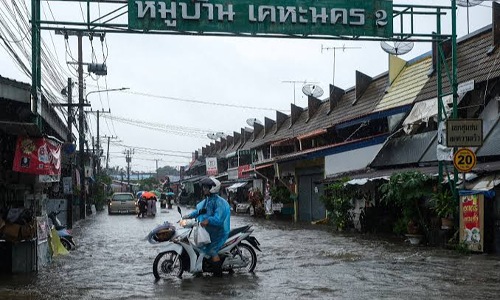
Heavy rains have triggered severe flooding across parts of Bangkok, Thailand, forcing nearly 4,900 residents to evacuate to shelters as floodwaters swept through roads and residential areas.
The flooding has disrupted movement across parts of the Thai capital, with motorists and pedestrians forced to navigate submerged roads and seek alternative routes.
SEE ALSO: NAFDAC Warns Nigerians As Fake Cowbell Milk Floods Market
According to the Bangkok Metropolitan Administration, about 52,000 households have been affected by the flooding, prompting authorities to declare a flood disaster and intensify emergency response efforts.
Emergency teams have been deployed to assist affected communities and move residents from vulnerable areas to safer locations as water levels rise.
Bangkok is accustomed to seasonal heavy rainfall, but intense downpours can overwhelm drainage systems, particularly in low-lying areas, resulting in widespread flooding and disruption.
Authorities are continuing to monitor affected locations while coordinating evacuations and other emergency measures.
For thousands of residents, the immediate priority remains securing safe shelter and protecting homes and livelihoods as authorities work to manage the situation and restore normal activities once the floodwaters recede.

US President Donald Trump has explained his decision to reject Iran’s latest proposal to reopen the Strait of Hormuz, saying Tehran was seeking an agreement because it was losing revenue.
Speaking to reporters at the White House, Trump said Iran wanted to immediately reopen the strategically important waterway but argued that the proposal was not acceptable to his administration.
“They want to make a deal, and I think that’s fine. I like making a deal, too, but that deal would not be acceptable,” Trump said.
SEE ALSO: How the Strait of Hormuz Attack Could Trigger a Fresh Global Oil Shock
According to the US president, Iran’s push to reopen the strait was driven by the economic pressure it was facing.
“What they want to do is immediately open the Hormuz Strait. Do you know why? Because they are dying,” Trump said.
“You know why they’re dying? Because they have no money coming in, because they get their money from the Hormuz Strait.”
Trump also claimed that the US had established an unprecedented naval blockade against Iran, describing it as “a wall of steel.”
“So they outsmarted themselves. We put up the greatest blockade ever in military history. It’s a wall of steel,” he said.
“And guess what? They don’t have any money now because they wanted to close the strait.”
The Strait of Hormuz is a major global energy shipping route, and disruption to traffic through the waterway has significant implications for international oil markets and countries that depend on energy imports.
Trump’s remarks came amid continued tensions between Washington and Tehran over the reopening of the strategic waterway and negotiations involving Iran.






JUST IN: Ex-Delta Governor Emmanuel Uduaghan Is Dead

Delta Begins ₦5bn Empowerment Scheme for 100,000 Beneficiaries
Alausa Hails Dangote Foundation’s Plan to Give Four Million Students IPO Shares

APC Campaign Council Sets Inaugural Meeting for Tuesday Ahead of Kaduna Flag-Off

Renaissance Capital Sees Significant Upside in Dangote Refinery, Lifts Valuation by 33.4%

Dangote Refinery IPO Elicits Participation in 90 Countries Globally

Trump’s Family Unveils New Cryptocurrency Platform

Senate Denies Receiving Petitions Against Tinubu’s Ambassadorial Nominees

Dangote Cement Lights Up Benue Host Communities With CSR Initiatives

Reps Recommend 3-year Jail Term For Aviation minister

Tems Sets New Record On Billboard Hot 100 Chart
