
International News
South Korean President Banned From Travel Amid Martial Law Backlash

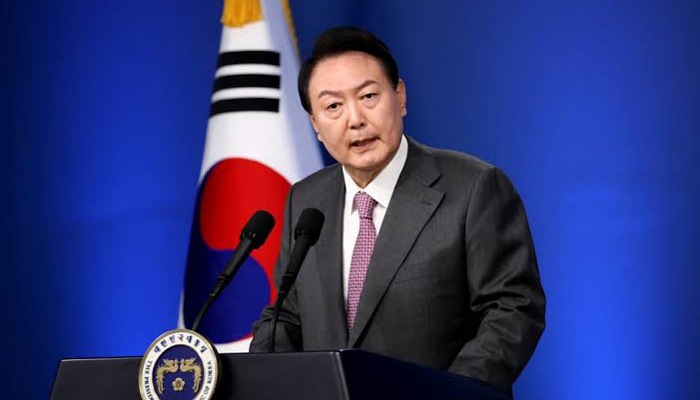
South Korean President, Yoon Suk Yeol has been banned from leaving the country, the Justice Ministry confirmed Monday, following a week of political chaos triggered by his brief declaration of martial law.
The ban marks the first time a sitting president has faced such a restriction in the nation’s history.
Recall that on December 3, Yoon ordered special forces and helicopters to the National Assembly in an attempt to impose martial law.
RELATED NEWS: Martial Law: South Korea Opposition Files Impeachment Motion Against President Yoon
Lawmakers swiftly overturned the decree, forcing Yoon to rescind the order. Although he survived an impeachment motion on Saturday, public anger has continued to mount, with large protests demanding his resignation.
Authorities are now investigating Yoon and his close allies for their roles in last week’s events, including allegations of insurrection.
Among those facing travel bans are former Defense Minister Kim Yong-Hyun, who is in custody, and former Interior Minister Lee Sang-min.
General Park An-su, who led the martial law operation, and Defence Counterintelligence Commander Yeo In-hyung have also been barred from leaving the country.
General Park was questioned by investigators on Monday as the probe intensified.
Yoon’s impeachment failed after members of his ruling People Power Party (PPP) walked out of the National Assembly, denying the opposition the required two-thirds majority.
In exchange for their support, Yoon reportedly agreed to delegate his powers to the prime minister and the PPP chairman.
“This is an unlawful, unconstitutional act of a second insurrection and a second coup,” said Park Chan-dae, floor leader of the opposition Democratic Party.
Critics argue that Yoon’s decision to hand power to unelected officials violates the constitution.
“It seems to resemble an unconstitutional soft coup,” said Kim Hae-won, a constitutional law professor at Pusan National University.
“Their attitude of placing themselves above the constitution mirrors that of insurrectionist Yoon Suk Yeol,” added Park Chan-dae.
Despite Yoon’s apology for the “anxiety and inconvenience” caused by his martial law order, his approval rating has plummeted to 11%, according to a recent Gallup poll.
Opposition leaders have announced plans for a second impeachment vote on Saturday, with massive protests expected outside the National Assembly.
The PPP’s claim that Yoon can remain in office while delegating his powers to party officials has also been widely criticized.
“If there are issues with the president, the constitution lays out clear procedures, such as suspension or impeachment,” said Professor Kim Hae-won.
The ongoing crisis has raised concerns about South Korea’s leadership amid tensions with nuclear-armed North Korea.
The Defense Ministry confirmed Monday that Yoon remains the official commander in chief, despite questions about his authority.
“Legally, (control of military forces) currently lies with the commander in chief,” said Defense Ministry spokesperson Jeon Ha-Kyou.






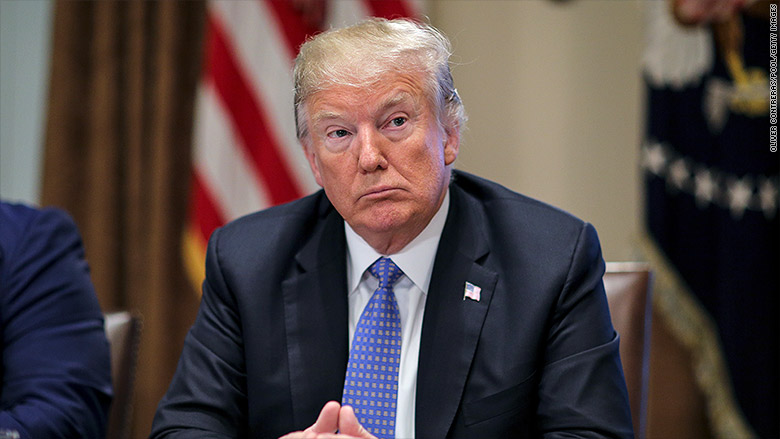

Federal agents raided the Washington, D.C., home of Democratic Congresswoman Ilhan Omar early Monday morning as part of an ongoing federal criminal investigation, the United States Department of Justice (DOJ) has confirmed.
Homeland Security Investigations agents arrived at the Minnesota congresswoman’s residence at about 6:00 a.m. Eastern Time, according to a report by Fox News.
SEE MORE: Trump Sparks Outrage With Shock Proposal to Rename New Mexico
The report said both the Department of Homeland Security (DHS) and the DOJ are involved in the investigation.
A DOJ spokesperson confirmed the operation, stating: “Today in the Washington, D.C. area, Homeland Security Investigations executed a judicially authorized search warrant secured by the Department of Justice.”
The spokesperson added: “This enforcement action is part of an ongoing federal criminal investigation.”
Details later……….
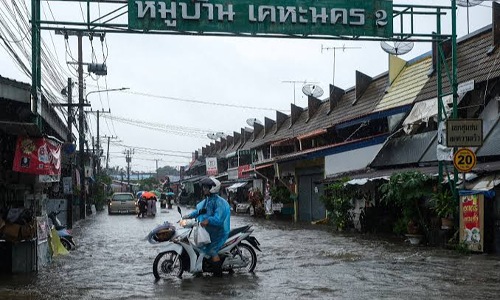
Heavy rains have triggered severe flooding across parts of Bangkok, Thailand, forcing nearly 4,900 residents to evacuate to shelters as floodwaters swept through roads and residential areas.
The flooding has disrupted movement across parts of the Thai capital, with motorists and pedestrians forced to navigate submerged roads and seek alternative routes.
SEE ALSO: NAFDAC Warns Nigerians As Fake Cowbell Milk Floods Market
According to the Bangkok Metropolitan Administration, about 52,000 households have been affected by the flooding, prompting authorities to declare a flood disaster and intensify emergency response efforts.
Emergency teams have been deployed to assist affected communities and move residents from vulnerable areas to safer locations as water levels rise.
Bangkok is accustomed to seasonal heavy rainfall, but intense downpours can overwhelm drainage systems, particularly in low-lying areas, resulting in widespread flooding and disruption.
Authorities are continuing to monitor affected locations while coordinating evacuations and other emergency measures.
For thousands of residents, the immediate priority remains securing safe shelter and protecting homes and livelihoods as authorities work to manage the situation and restore normal activities once the floodwaters recede.
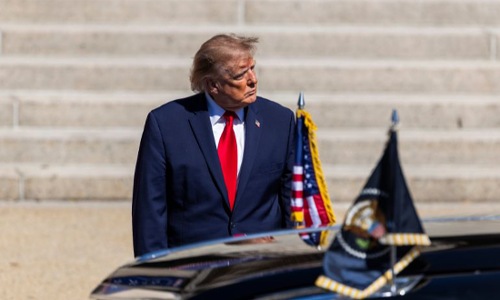
US President Donald Trump has explained his decision to reject Iran’s latest proposal to reopen the Strait of Hormuz, saying Tehran was seeking an agreement because it was losing revenue.
Speaking to reporters at the White House, Trump said Iran wanted to immediately reopen the strategically important waterway but argued that the proposal was not acceptable to his administration.
“They want to make a deal, and I think that’s fine. I like making a deal, too, but that deal would not be acceptable,” Trump said.
SEE ALSO: How the Strait of Hormuz Attack Could Trigger a Fresh Global Oil Shock
According to the US president, Iran’s push to reopen the strait was driven by the economic pressure it was facing.
“What they want to do is immediately open the Hormuz Strait. Do you know why? Because they are dying,” Trump said.
“You know why they’re dying? Because they have no money coming in, because they get their money from the Hormuz Strait.”
Trump also claimed that the US had established an unprecedented naval blockade against Iran, describing it as “a wall of steel.”
“So they outsmarted themselves. We put up the greatest blockade ever in military history. It’s a wall of steel,” he said.
“And guess what? They don’t have any money now because they wanted to close the strait.”
The Strait of Hormuz is a major global energy shipping route, and disruption to traffic through the waterway has significant implications for international oil markets and countries that depend on energy imports.
Trump’s remarks came amid continued tensions between Washington and Tehran over the reopening of the strategic waterway and negotiations involving Iran.






Why Ebola Outbreaks Keep Returning to Africa, Dr Jean Kaseya Explains

Peter Obi Meets UK Officials, Diaspora Stakeholders on Rebuilding Nigeria

Grains-Laden Truck Falls on BRT Lane in Lagos

Ogun Police Chief Urges POWA to Turn Skills Centre into Industrial Hub

Thor Empowers Host Communities with 10 Cassava, Palm Oil Processing Plants

FG Puts Daily Gas Output at 8bcf

Trump’s Family Unveils New Cryptocurrency Platform

Senate Denies Receiving Petitions Against Tinubu’s Ambassadorial Nominees

Dangote Cement Lights Up Benue Host Communities With CSR Initiatives

Reps Recommend 3-year Jail Term For Aviation minister

Tems Sets New Record On Billboard Hot 100 Chart

There’s a quiet elegance in the way you express your thoughts, each word chosen with such care and precision.