
Opinion/Feature
The Rebirth of Edo Line

By Fred Itua
In the heart of Nigeria’s South-South region lies a state uniquely positioned as a transit and gateway corridor—Edo State.
For decades, its strategic location made it a pivotal hub for movement across the country, linking the South East, South South, South West, and even Northern Nigeria. It was this geographical advantage that inspired visionary leaders of the past to establish an indigenous, state-owned transport network to serve both the people and the nation. One of such visionary projects was the creation of Edo Line, an iconic symbol of mobility, enterprise, and progress, birthed by the late Dr. Samuel Ogbemudia.
Edo Line was more than just a transportation firm—it was a symbol of Edo pride, a public utility that once stood tall among transport networks in Nigeria. From the 1980s through the early 2000s, the company offered efficient inter-state services and provided hundreds of jobs for Edo youths. However, by 2010, this once-reliable system began to crumble under the weight of neglect, poor maintenance, and policy inconsistencies. Successive administrations tiptoed around its revival without meaningful commitment.
ALSO READ: Sahara Group’s ‘IGWE’ Initiative Harnesses Gamification to Rally Sustainability
In 2017, the administration of former Governor Godwin Obaseki finally closed that chapter by shutting down Edo Line indefinitely. The directive came with the relocation of remaining staff to the Ministry of Transport, and the company’s facilities were abandoned. Buses and courier units were left to rot; offices became dilapidated shells of their former selves. With a mounting debt of over N1.5 billion, the company seemed destined for liquidation rather than rehabilitation. Edo Line joined the list of public utilities choked by the dust of time and government inaction.
But history, as it is often said, is kind to leaders who confront problems head-on. In just a few weeks after his inauguration, Governor Monday Okpebholo demonstrated that leadership is not just about grand promises but timely action. Accompanied by his Deputy, Hon. Dennis Idahosa, the Governor visited the ruins of Edo Line along Mission Road, Benin City. What he met was a graveyard of lost dreams—but he saw more than decay; he saw potentials.
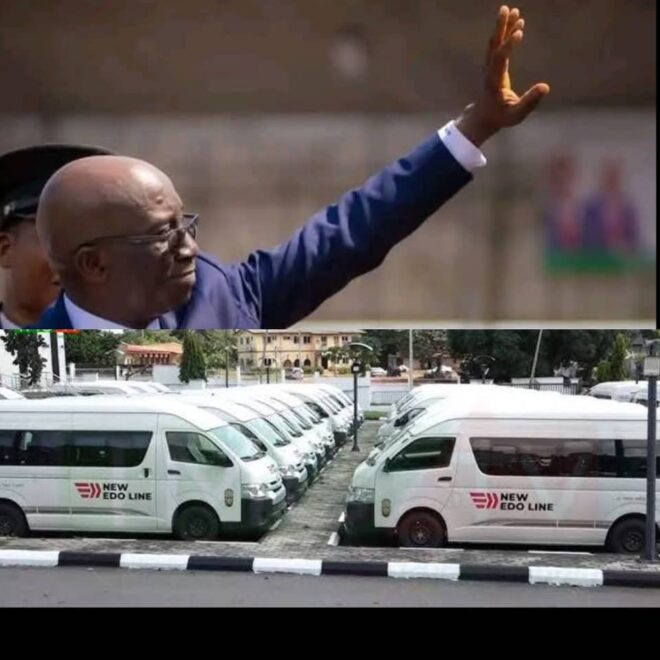
By February 2025, a flurry of activity began: the Governor approved the purchase and commissioning of over 100 new Toyota Hiace buses—a fleet that signaled not only revival but modernization. Unlike previous efforts that were trapped in bureaucracy or lip service, this intervention was swift, strategic, and structured. The New Edo Line was reborn—not as a recycled version of its former self—but as a rejuvenated model ready to compete and serve.
Now, with operations set to begin on June 27, 2025, the once comatose Edo Line will roar back to life after 15 years of abandonment. For a state that sits at the crossroads of national commerce and travel, this is not just a return; it is a renaissance.
The implications of this revival go beyond intra-state travel. With the new fleet and improved infrastructure, the New Edo Line is poised to become the heartbeat of public transportation in Southern Nigeria. As a transit state, Edo serves travelers from Lagos heading to the East, from the North seeking access to the ports in the South South, and from neighboring states like Delta, Kogi, and Ondo.
This means more than movement—it means commerce. It means safer travel, job creation, digital ticketing systems, courier revival, and the resurgence of Edo’s logistical power. Moreover, this move aligns with regional integration plans within the Southern Governors’ Forum and opens up Edo for greater collaboration and investments in the transport and logistics sector.
The ripple effect? With increased mobility comes urban development, stronger inter-state business ties, and enhanced accessibility for rural communities who rely on efficient public transport for survival and economic activity.
That such a transformative initiative was accomplished within the first 100 days of Governor Okpebholo’s administration is not just commendable—it is historic. In a political climate where even basic infrastructure can take years of planning and politicking, this swift execution underscores the Governor’s hands-on leadership, sense of urgency, and love for the people.
In a time when cynicism about government action runs deep, the New Edo Line rebirth rekindles hope. It is proof that with the right leadership, public utilities can be resuscitated; that legacies can be preserved and modernized; and that the government can still work—fast and effectively—for the people.
The buses may be new, but what is truly new is the vision steering the wheels. The New Edo Line stands today as a testament to the power of political will, the relevance of Edo as a regional mobility hub, and the necessity of investing in infrastructure that moves people, goods, and ideas.
Governor Monday Okpebholo has done in 100 days what took others more than a decade to ignore. And as the engines of the New Edo Line hum back to life this June, Edo people—and indeed Nigerians—can be assured that this journey is not just about buses. It is about destination. It is about dignity. It is about a government in motion, driven by purpose.
Edo Oyeeeee!
Fred Itua, the Chief Press Secretary to Governor Monday Okpebholo of Edo State, wrote from Benin City.






NEWS
Edo Govt To Raise N160bn For Climate Project While Kidnapping Ravages The State… Is That What The People Need?

As kidnapping and violent crime continue to escalate across Edo State, the government has announced plans to raise N160 billion to tackle ecological challenges, raising serious questions about priorities in the state.
The Executive Chairman of the Edo State Ecological Fund and Management Commission, Blessing Agbomhere, revealed during a press briefing on Wednesday that the funds would be raised through the Ecological/Climate Trust.
According to him, the Okpebholo Green Revolution for Edo is scheduled to launch next week.
SEE ALSO: Edo Cracks Down on Drug Cartels, Arrests Breastfeeding Mother, Six Others
Agbomhere stated that Edo’s three-year budget would not be enough to remediate gully erosion sites across the state.
The over 60 gully erosion sites identified would be addressed in phases, with some remediation projects costing between N5 billion and N20 billion each.
The government also plans to plant one million trees in four years.
He further raised concerns over illegal sand mining, particularly in Edo South Senatorial District, revealing that many operators have no plans to restore the land after their operations, which continues to exacerbate erosion problems.
“A lot of companies are operating in Edo State. After their operation, they will leave the state without remediating the environment. We are calling on them to tell us their plans for remediation when they leave,” Agbomhere said.
While ecological initiatives are undeniably important, the timing and focus of the government are being questioned.
Kidnapping and insecurity are surging across the state, yet attention and resources are being directed toward environmental projects instead of immediate security measures.
At a time when fear dominates daily life for Edo citizens, raising millions for ecological projects while kidnappers roam freely sends a troubling message: are citizens’ lives being sidelined in pursuit of long-term environmental goals?
Biz Tellers raises the concern: shouldn’t security take precedence over climate projects when residents’ lives are under threat? The government insists that addressing ecological challenges is crucial for long-term development, but for many, this does not answer the urgent question of public safety.
As Edo faces both ecological and security challenges, the debate over government priorities intensifies.
The pressing question remains: is this really what the people need right now?
By Fred Itua
Godwin Obaseki’s latest outburst is not a surprise. It is simply the continuation of a pattern that Edo people came to recognize too late. His years in office were marked by intolerance, vindictiveness and a violent streak that constantly simmered beneath the surface. Those who worked closely with him still carry the scars of his temperament. His former deputy, Philip Shaibu, is the most glaring example.
Whatever their disagreement may have been, no rational leader plots the humiliation and removal of a deputy he once described as a brother. Yet Obaseki manipulated every institutional lever available to him to settle a personal score, using the House of Assembly as a pawn to crush a man whose only crime was falling out of favour with the lord of Osadebe Avenue.
In October 2022, Obaseki’s hateful tendencies were expended on those he promised to serve. He supervised the demolition of roughly one hundred homes across Oke-Oroma, Irhirhi-Obazagbon and Ogheghe communities. Residents insisted they held valid documents, including Certificates of Occupancy, yet he pushed ahead in defiance of a subsisting court order that had restrained any action pending the determination of their suit. The result was devastating. Thousands were displaced and property worth billions of naira were reduced to rubble. Such a vindictive man!
Edo people saw the full extent of this violence during the 2024 governorship election when Obaseki stood before cameras and threatened that Edo would burn if his preferred candidate lost. Those words were not the empty rant of a frustrated politician. They came from a man with a history of weaponizing state power, a man whose administration armed loyalists and created networks of political enforcers who blended easily into the criminal elements that then turned their guns on innocent citizens.
ALSO READ: Edo Cracks Down on Drug Cartels, Arrests Breastfeeding Mother, Six Others
It is no coincidence that the early days of the current administration were choked with spikes in kidnapping and armed robbery. These were not random crimes. They were the desperate convulsions of an ecosystem built, funded and empowered by Obaseki himself.
Governor Monday Okpebholo has had to stabilize a state that was deliberately left volatile. Through calm leadership and quiet strength, he has managed to rein in the chaos and restore public confidence. But Obaseki, instead of retreating into reflection, has doubled down.
His recent video in Birmingham reveals a man who cannot bear the reality that Edo people have moved on. He accused Okpebholo of being “stupid”, boasted that he is mobilizing the international community against him and President Bola Ahmed Tinubu, and threatened that the governor “will see”.
These are not harmless statements from an angry former office holder. They are calculated threats from someone who has never hidden his desire to destabilize Edo State whenever power slips from his grip.
He claims that a governor from Irrua cannot dictate to people in Benin. That remark alone exposes the dangerous tribal undertone of his politics. For eight years, he exploited ethnic sentiment to divide communities and isolate opponents. Now, he is attempting to ignite the same divisive flame against a governor who has only focused on governance, inclusiveness and development.
Obaseki’s language in that video is not only reckless, it is incendiary. It hints at an attempt to stir resentment, inflame divisions and rally hostility toward a government that is working hard to rebuild the damage he left behind.
His recent globe-trotting under the guise of “meet and greet” is now clearer for what it is: an effort to secure foreign sympathy, funding and legitimacy for a domestic political battle he has already lost. When a former governor openly brags about mobilizing the diaspora and the global community against the current leadership of his own state, it raises valid questions about intent.
What exactly does he need international pressure for? Why is he desperately trying to create a narrative of crisis where none exists? And who are the people he hopes to recruit from abroad? Edo people have not forgotten that this same man once threatened to burn down Nigeria during an election.
They have not forgotten that his private “security structure” terrorized communities under the cloak of political loyalty. They understand the implications of a former governor seeking global support while trading in fear and hostility.
The uncomfortable truth is that Obaseki’s comments suggest a willingness to collaborate with external actors to undermine the peace of Edo State. A man who once equipped foot soldiers and political enforcers is now boasting about global mobilization.
The link is not far-fetched. His post-tenure travel pattern, sudden desperation and inflammatory rhetoric open the possibility that he is seeking funds or tacit support to revive the political machinery that once served him; a machinery that slipped into criminality after he left office. Edo cannot afford to overlook this. A man who once used threats to bend institutions is now using threats to intimidate a sitting governor.
And yet, despite Obaseki’s attempt to twist reality, Monday Okpebholo has not threatened him. He has not weaponized ethnicity. He has not responded with abuse. All he has done is to remind the public that the records of Obaseki’s misrule are there for anyone to examine.
The refusal to swear in duly-elected lawmakers. The manipulation of the Assembly to serve private interests. The unprecedented decision to withhold the swearing-in of judges recommended by the National Judicial Council. The demolition of the central hospital without providing a viable alternative for ordinary people. These actions were not just bad governance; they were the height of arrogance and indifference to the people he claimed to represent.
It is ironic that Obaseki now accuses others of threatening him when his own record is littered with acts that undermined the wellbeing of Edo people. His fear is not Governor Okpebholo. His fear is accountability. His fear is that the fog of propaganda can no longer cover the damage he inflicted on institutions, communities and public trust. And so he runs abroad to find new allies, hoping that distance will distort the truth.
His attacks on Governor Okpebholo’s loyalty to President Bola Tinubu are even more revealing. By insisting that Okpebholo should not deliver votes to the President, Obaseki exposes the bitterness that comes from losing political relevance. But governance is not about ego. Performance is what earns support. And Okpebholo’s quiet but consistent reforms across infrastructure, security, social welfare and public administration already place him miles ahead of the eight years of stagnation that Obaseki left behind. Edo people are not blind. They know who is working. They know who listens. They know who respects them. No amount of foreign posturing will change that.
Obaseki’s latest rant is a dangerous escalation from a man struggling to remain politically relevant. It is an open threat to peace and a signal that he is willing to drag Edo into conflict just to nurse his bruised pride. Edo people and the federal government must treat this with the seriousness it deserves. A former governor openly encouraging dissent abroad while tribalizing politics at home is a security concern. His record, his words and his behavior suggest that he is not acting alone.
The time has come for security agencies to take Obaseki’s latest comments and conduct seriously. His public threats, global mobilization and divisive rhetoric raise red flags that cannot be ignored. A thorough probe is needed to determine the intent behind his statements and the networks he is attempting to activate.
His known supporters, online loyalists and political enforcers must be properly profiled and monitored to ensure they do not undermine the peace Edo State is currently enjoying. Edo cannot afford to slip back into instability, and every institution responsible for protecting public safety must act decisively before words escalate into something more dangerous.
Fred Itua, the Chief Press Secretary to Governor Monday Okpebholo wrote from Benin City, Edo State

I have received calls, messages and other inquiries regarding the revocation of the CofO of Presco Plc by Governor Monday Okpebholo. The Secretary to State Government, Barr. Umar Musa Ikhilor, has robustly explained the issues.
Unfortunately, some folks, for obvious reasons, are still yearning for more answers. I’ll explain the facts and I hope this helps.
It has been established that the published Revocation Notice didn’t pass through the appropriate channels. Again, the actual number of hectares intended for excision from Presco Plc’s total landholding was grossly misrepresented in the published text.
For clarity, the Edo State Government has not revoked Presco Plc’s Statutory Right of Occupancy. What was under technical consideration was the excision of approximately 20 hectares—a clearly defined area—strictly limited to the portions of land containing strategic crude oil wells.
This excision became necessary because no individual or company can lawfully exercise proprietary rights over land where mineral resources are located, as such resources are vested exclusively in the Federal Government.
Section 44(3) of the Constitution of the Federal Republic of Nigeria (1999, as amended) provides that:
“Notwithstanding the foregoing provisions of this section, the entire property in and control of all minerals, mineral oils and natural gas in, under or upon any land in Nigeria shall vest in the Government of the Federation…”
ALSO READ: Dangote Group Contracts SAIPEM, EIL, others for Fertiliser Expansion in Nigeria, Ethiopia
Section 1 of the Petroleum Industry Act, 2021 similarly states that:
“…the entire ownership and control of all petroleum in, under or upon any lands in Nigeria shall be vested in the State (Federal Government)…”
Section 28 of the Land Use Act (1978) empowers government to revoke rights of occupancy strictly for overriding public interest, which includes matters relating to mineral exploitation.
The Edo State Government advises the general public, stakeholders, and Presco Plc to disregard the notice in its entirety.
Meanwhile, Governor Monday Okpebholo has initiated a formal administrative review to strengthen internal controls to prevent future breaches.
The administration of Governor Monday Okpebholo reiterates its commitment to transparent land administration, orderly engagement with investors, and the protection of public interest, particularly in matters involving national strategic assets such as oil and gas assets.
So, my people, no cause for alarm.
Fred Itua is the Chief Press Secretary to Governor Monday Okpebholo of Edo State.





Fuel Price Shock: Nigerians May Soon Pay ₦1,500 Per Litre – Marketers Warn

Political Earthquake in Zamfara as Gov Lawal Dumps PDP for APC

Court Pushes Malami, Son’s Terrorism Financing Trial to April 15

African Club Football Gets Major Financial Boost as CAF Hikes Prize Money

Abramovich Clashes with UK Gov’t Over £2.35bn Chelsea Sale Funds

Global Crisis: Attacks on Schools Skyrocket 166% – UN Sounds Alarm on Children’s Safety

Trump’s Family Unveils New Cryptocurrency Platform

Reps Recommend 3-year Jail Term For Aviation minister

Senate Denies Receiving Petitions Against Tinubu’s Ambassadorial Nominees

Dangote Cement Lights Up Benue Host Communities With CSR Initiatives

Things To Know About Threads, Zuckerberg’s Twitter-like App
