
Energy
4,000 CNG Trucks: Tanker Drivers Panic as Dangote, Marketers Tighten Distribution Deal


With less than 30 days to the commencement of the highly anticipated rollout of 4,000 Compressed Natural Gas trucks by the Dangote Refinery and Petrochemical Limited, industry stakeholders have signalled an alignment with the refinery’s plan to begin direct fuel distribution to marketers and critical sectors of the economy from August 15.
According to Sunday PUNCH checks revealed that as of Friday, no fewer than 25 marketers had signed up with the Dangote refinery for the direct fuel distribution deal.
The figure rose from an initial three, signalling increasing alignment between the indigenous refinery and oil marketers, it adds.
However, the development is fuelling concerns among tanker drivers, who fear massive job loss when Dangote begins direct supply of Premium Motor Spirit to the oil marketers.
ALSO READ: Obi’s Birthday Echoes Loud in Sokoto as ‘Obidients’ Shower Patients with Gifts
The refinery had last month announced its intention to supply PMS and diesel directly to petroleum marketers, retail dealers, manufacturers, as well as major players in the telecommunications and aviation industries, a move seen as a major disruption to Nigeria’s traditional fuel supply chain.
25 Strategic Partners
In what appears to be growing market confidence in the refinery’s logistics scheme, the number of strategic partners collaborating with Dangote for the fuel distribution initiative has now surged from three to 25, officials have confirmed.
A senior executive at Dangote Group, was cited by Sunday PUNCH revealed that marketers were registering ahead of the August launch, with the refinery preparing to move products nationwide using its fleet of 4,000 trucks.
“Yes, more marketers are now registering with us ahead of the planned free distribution of petroleum products using 4,000 trucks. Right now, the number of strategic partners has grown to 25. We started with three partners but now, it has jumped to 25 partners,” the Dangote official said.
The refinery had said the move is part of an effort to fill the gap created by Nigeria’s dependence on imports and to ensure the availability of refined products across the country.
Stakeholders say the free distribution scheme may significantly impact pump prices and ease logistics challenges, especially in northern Nigeria.
However, the refinery’s growing influence in the downstream sector has sparked debates around market dominance, regulation, and the long-term impact on local competition.
Marketers Left with no Choice
Giving the latest market reaction to the development, the National Publicity Secretary of the Independent Petroleum Marketers Association of Nigeria, Chinedu Ukadike, admitted that marketers were left with little choice but to align with Dangote.
“Well, we don’t have any option. Dangote has become the only supplier of petroleum products in Nigeria and West Africa. I don’t know if they have conquered other markets but I am talking authoritatively on information at my desk as the IPMAN spokesperson.
“We don’t have any other alternative and we are ready to partner. Most of us are ready to collaborate with Dangote. Marketers have applied to benefit from the free distribution scheme,” Ukadike told Sunday PUNCH.
According to him, the decision is driven by economic realities, especially the high cost of fuel, which has crippled the profitability of retail operations.
“Let me also state that whatever would bring petroleum price low at the dispensing point is the fulcrum of IPMAN members. Once the price is lower, the product will move faster, and there will be a gainful return on investment, but anytime you find that the product is high, contrary is the case.
“Sometimes, we don’t even finish one truck of petroleum product in a month and the running cost is accumulating. It is stagnant and can’t be waived. You can’t say that because you were unable to finish one truck in a month, the salaries of your workers won’t be paid. Nobody listens to that,” he explained.
Ukadike warned, however, that the current state of monopoly is unsustainable in the long term.
“We also charge other refineries to please come up, so that there can be competition, especially government-owned refineries. This will put a balance to the issue of monopoly.
“We simply don’t have any choice. But we won’t starve Nigerians. We are no longer importing, which means the refinery is supplying government too. So, we just have to build more refineries to ensure the price comes down.”
Tanker Drivers Panic
But while many independent marketers are embracing the refinery’s free distribution offer, there is growing panic over possible job losses among tanker drivers.
Sunday PUNCH’s interactions with the leadership of tanker drivers on Saturday revealed increasing concern about their future as more petroleum marketers align with Dangote’s plan to distribute fuel directly to filling stations and bulk consumers.
There are fears that the new arrangement could phase out tanker drivers and render their trucks redundant.
However, some of these drivers may eventually be absorbed into the Dangote workforce, Sunday PUNCH learnt.
As the Dangote refinery currently supplies a significant share of the fuel in circulation, most drivers presently lift products from its gantries. But with the planned deployment of Dangote-owned trucks, many fear that thousands of independent drivers may soon be out of work.
Although other depot owners and marketers still operate their own trucks, it is believed that many may opt for the free delivery option to cut logistics costs.
“Some of the marketers may need to park their trucks to enjoy free delivery,” an analyst noted.
Speaking with our correspondent on Saturday, the National President of the National Association of Road Transport Owners, Yusuf Othman, confirmed that stakeholders were planning to meet over the matter to make their positions known.
He, however, declined to disclose how the scheme would affect his members, saying consultations were ongoing.
“I am not going to say anything about it because we are in discussion,” Othman said.
Asked whether the discussions were with Dangote, he replied, “The discussion is with the stakeholders generally.”
In a similar vein, suppliers of petroleum products have also expressed concerns that if Dangote begins to sell petrol, diesel, and aviation fuel directly to bulk consumers such as filling stations, telecom firms, and industries, they and their drivers could lose their livelihoods.
Consequently, the Natural Oil and Gas Suppliers Association of Nigeria has scheduled a National Executive Council meeting to discuss the implications of Dangote’s distribution plan.
According to a notice issued by the association’s Secretary-General, Tunde David, the meeting, scheduled to hold in Abuja on July 31, followed due consultations with NOGASA’s National President, Benneth Korie.
It partly read, “Following due consultations with the National President, Mr Benneth Korie, DOI; notice is hereby given for the holding of the association’s NEC meeting on Thursday, 31st July, 2025, at Chida Hotel, Jabi, Abuja, by 10 a.m.”
PETROAN Urges Caution
Meanwhile, the Petroleum Products Retail Outlets Owners Association of Nigeria has warned against what it described as a “Greek gift” by Dangote.
The National President of PETROAN, Billy-Gillis Harry, drew parallels with past monopolies in Nigeria’s flour, sugar, and cement industries, warning that such distribution schemes may only offer temporary relief before ushering in higher prices.
He said, “I think Nigerians need to be careful about accepting a ‘Greek gift’. We need to be much more insightful, as we have experienced it in different spheres of the economy, whether it is flour, sugar, or cement.
“The methods have never been any different. So, if you go round the country, you would see containers of cement at selling points. But it did not at any time reduce the cost of cement.
“So, there is no anticipation that when everybody is drummed out of the business by these kinds of gifts, we wouldn’t get back to the same position where we would start looking to buy petroleum products for N2,500 per litre. It has happened in other areas. We are courageous enough to stand by our point.”
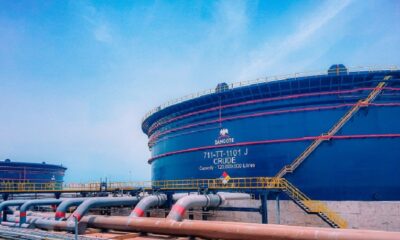
The 650,000-barrel-per-day refinery came on stream in January 2024, first rolling out diesel and aviation fuel A1.
PMS rollout followed nine months later, in September 2024.
As of February 2025, the refinery disclosed that it had reached 85 per cent of its installed capacity, expressing confidence in the speedy attainment of full capacity.





Joseph Ambakederimo, convener of the South-South Reawakening Group, has questioned the accountability of Nigeria’s crude oil forward sales, demanding clarification on the volume of crude lifted, outstanding balances and the use of upfront payments.
Speaking during an interview on Arise TV on Sunday, Ambakederimo expressed concern over the monitoring of crude oil transactions, questioning who was responsible for tracking deliveries and providing feedback on the arrangements.
“We don’t even know who is monitoring and giving us the feedback of the barrels of crude that have been lifted on forward sales basis,” he said.
SEE MORE: South-South Group Opposes Coastal Road Alignment With East-West Road
He challenged the Nigerian National Petroleum Company Limited (NNPC) to provide details of the transactions, including the quantity of crude already lifted, the outstanding balance and whether the agreed deliveries had been completed.
“Today, can we get this from NNPC? How much have they lifted? What is the balance remaining? Have they been completed?” he asked.
Ambakederimo also questioned how the money collected upfront under the arrangements had been spent, demanding an explanation of its use.
“That money that was collected upfront, what was the use of the money? Can you justify it?” he asked.
He argued that Nigeria should make better use of its natural resources to accelerate infrastructure development and improve living conditions.
Citing land reclamation projects in the United Arab Emirates, Ambakederimo said Nigeria could explore similar opportunities to create additional land for residential and other developments.
He recalled seeing a signpost while travelling from Dubai to Abu Dhabi describing a project to reclaim land from the sea, using the example to highlight the development possibilities he believes Nigeria could explore.
The South-South Reawakening Group convener also argued that Nigeria could reclaim land in suitable areas, provided environmental concerns were properly managed.
He called for the country to translate its natural resource wealth into infrastructure and improved living conditions, stressing the need for greater accountability in crude oil transactions.
Oil output from the United Arab Emirates (UAE) rose to record levels in September, underscoring its resilience even amidst the Middle East crises and liberation from OPEC+ limits.
The International Energy Agency (IEA) issued the data in its monthly report, adding that Abu Dhabi raised total oil production, including condensates, by 400,000 bpd to 5.3 MMbpd.
According to the IEA, the UAE bolstered crude output to more than 4.4 MMbpd, nearing its maximum capacity, which surpasses the previous highs for total oil in August, and crude oil in June.
READ ALSO: Africa’s Energy Security Conversations Pull Industry Executives Together
The UAE has been one of the most successful among regional producers in restoring flows through the Strait of Hormuz, by drawing on a fleet of tankers to discreetly shuttle cargoes through the chokepoint and then transfer them onto other vessels. In addition, the country’s decision to leave the Organization of the Petroleum Exporting Countries (OPEC) as of May has freed it from the group’s output caps, a source of frustration for years.
Its gains contributed to a wider recovery in flows from Gulf producers, which reached more than 75% of pre-war levels in September, led by Saudi Arabia, according to the Paris-based IEA.
Still, it’s unclear how far the regional rebound has withstood a new wave of Iranian attacks on tankers transiting Hormuz, and escalating hostilities carried out by the Houthi rebel faction in Yemen.
The UAE depleted its observable above-ground inventories at a record pace of more than 270,000 bpd in September, drawing them to an all-time low, according to the IEA.
Africa’s gas potential and strengthening the continent’s energy security would take centre stage at the Africa Interviews Sustainability Forum (AISF 2026) scheduled for Wednesday, October 21, in Lagos.
Biztellers reports that top officials of Oando Plc and Renaissance Africa Energy Company Limited, Ayotola Jagun and Tony Attah, respectively, will be leading other industry leaders in the discussion.
Jagun, Oando’s Executive Director, Chief Corporate Services and Sustainability Officer, and Attah, Managing Director and Chief Executive Officer of Renaissance Africa Energy Company Limited, will participate in a panel discussion alongside Lamé Verre of Lean In Equity & Sustainability (LiNES) and Dapo Filani, Managing Director and Chief Executive Officer of Waltersmith.
The panel will examine Africa’s energy security and the role of natural gas in the continent’s energy transition.
READ ALSO: 30 Nigerians Bag Postgraduate Scholarship from NNPC Ltd, Eni
The forum, launched in 2024, is holding its third edition under the theme, “Energy Security and Africa’s Energy Transition: Defining the Role of Gas.”
This year’s gathering will explore how African countries can strengthen energy security, attract investment in gas development and balance growing energy demand with sustainability objectives.
Verre, a London-based energy and sustainability executive, is Co-founder and Chair of the Advisory Board of LiNES. She will bring her international experience in sustainability, decarbonisation and low-carbon development to the discussion. Her work spans low-carbon initiatives across sectors, including marine, the built environment, forestry, land and agriculture.
Jagun brings extensive experience in corporate governance, regulatory compliance, enterprise risk management and sustainability. Her contribution will provide a corporate sustainability and governance perspective on the relationship between energy development, environmental responsibility and Africa’s transition priorities.
Attah, a former Managing Director and Chief Executive Officer of Nigeria LNG Limited, has extensive experience in the oil and gas industry, particularly in natural gas development and major energy operations.
Filani leads Waltersmith, an indigenous Nigerian energy company with interests across the oil and gas value chain. His participation will highlight the role of indigenous energy companies in strengthening domestic energy capacity and supporting economic development.
The panel will consider what is required to unlock greater investment in Africa’s gas sector, how natural gas can support industrial growth while advancing sustainability, and what practical measures could help translate the continent’s energy ambitions into tangible outcomes.
Beyond the panel discussion, AISF 2026 will provide opportunities for engagement among senior energy executives, policymakers, investors and business leaders.






JUST IN: Ex-Delta Governor Emmanuel Uduaghan Is Dead

Delta Begins ₦5bn Empowerment Scheme for 100,000 Beneficiaries
Alausa Hails Dangote Foundation’s Plan to Give Four Million Students IPO Shares
APC Campaign Council Sets Inaugural Meeting for Tuesday Ahead of Kaduna Flag-Off

Renaissance Capital Sees Significant Upside in Dangote Refinery, Lifts Valuation by 33.4%

Dangote Refinery IPO Elicits Participation in 90 Countries Globally

Trump’s Family Unveils New Cryptocurrency Platform

Senate Denies Receiving Petitions Against Tinubu’s Ambassadorial Nominees

Dangote Cement Lights Up Benue Host Communities With CSR Initiatives

Reps Recommend 3-year Jail Term For Aviation minister

Tems Sets New Record On Billboard Hot 100 Chart

8xunmv
vpkf21
3xi1wl
Just a smiling visitant here to share the love (:, btw great design.
You have brought up a very great points, thankyou for the post.
You have brought up a very superb points, regards for the post.
Regards for helping out, wonderful information.
You really make it seem really easy along with your presentation but I in finding this matter to be actually something which I think I would by no means understand. It seems too complex and very broad for me. I am taking a look forward to your subsequent post, I¦ll attempt to get the cling of it!
Hey there! I know this is kinda off topic but I was wondering which blog platform are you using for this website? I’m getting sick and tired of WordPress because I’ve had issues with hackers and I’m looking at alternatives for another platform. I would be awesome if you could point me in the direction of a good platform.
Hi! I’ve been following your website for a long time now and finally got the bravery to go ahead and give you a shout out from Dallas Texas! Just wanted to tell you keep up the excellent work!
Great write-up, I am regular visitor of one¦s web site, maintain up the nice operate, and It is going to be a regular visitor for a long time.
Regards for this post, I am a big big fan of this internet site would like to continue updated.