
Business
Dangote Sugar Shareholders Approve N500bn Rights Issue for Strategic Expansion

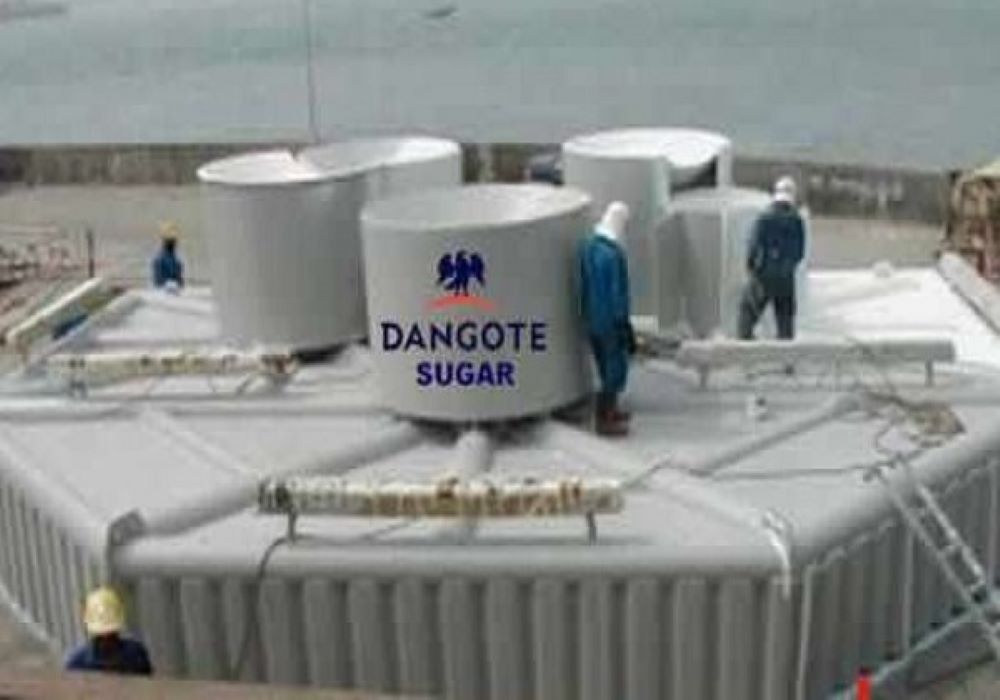
Dangote Sugar Refinery Plc has received shareholders’ approval for a N500 billion Rights Issue, thus positioning the company to strengthen its financial standing, expand its capital base, and accelerate strategic initiatives.
The Rights Issue, the shareholders reasoned will aid the Company in its ambitious backward integration projects.
The approval was given at the Company’s 20th Annual General Meeting held Wednesday in Lagos during which the Shareholders commended Dangote Sugar’s robust performance over the past year, underscoring their support for the organization’s ongoing evolution and future plans.
Addressing shareholders, Dangote Sugar Chairman, Mr. Arnold Ekpe remarked that the year under review saw a marked improvement in performance, despite a challenging economic environment, noting that revenue growth and enhanced EBITDA demonstrate positive operational momentum. However, profitability was weighed down by a foreign exchange loss of N46.7 billion and additional finance costs totaling N128.6 billion.
The Group, he said, posted a turnover of N829.2 billion, a 25 percent increase over 2024 adding “the loss for the year improved to N64.1 billion from N270.9 billion in the prior year, while EBITDA rose to N149.6 billion, up from N43.0 billion.”
Despite these hurdles, Ekpe assured shareholders that decisive actions are underway to boost operational efficiency and revenue growth. “With shareholder backing for the rights issue, we are in a strong position to bolster our balance sheet, setting the stage for future growth and profitability,” he said.
The Chairman emphasized the significance of the backward integration program themed, “Sugar for Nigeria” as a cornerstone of the company’s strategic vision. “This initiative is expected to drive profitability and value creation, reduce import dependency, mitigate foreign exchange risks, generate employment, and support local farmers through the out grower scheme.
“Our objective is to produce 1.5 million metric tonnes of sugar annually from domestically cultivated sugarcane. This involves developing approximately 45,000 hectares, with 2.7 million tonnes of cane earmarked for Numan and 3.35 million tonnes for Nasarawa. Achieving this goal requires substantial investments in land development and production capacity over the next five years,” Ekpe stated.
ALSO READ: Dangote Supplies over 72% of Nigeria’s Petrol as Consumption Falls 17%
Looking forward, he affirmed the company’s commitment to sustainable growth, positive impact, and enhanced profitability, saying that “we will continue optimizing our operations, pursuing market expansion opportunities, and increasing our presence across the nation. Aligned with the Dangote Group’s Vision 2030, we are dedicated to investing in our workforce and technology to consistently deliver exceptional products and customer satisfaction.”
The Group Managing Director and CEO of Dangote Sugar, Thabo Mabe, added that Dangote Sugar remains the sole producer of edible refined granulated white vitamin A fortified sugar, sourced from its backward integration site at Numan.
He mentioned that the company is diligently working to secure approximately $1.3 billion needed to fulfill its commitment to achieving a production target of at least 600,000 tonnes annually by 2030. “We have revised our strategic development plan to meet the 2030 objectives, leveraging the combined potential of DSR Numan Operation and Nasarawa Sugar Company Limited estates. This integrated plan targets substantial cane production of around 6.05 million tonnes across 45,000 hectares from both sites.”
At the AGM, a shareholder, Mrs. Bisi Bakare, commended Dangote Sugar Refinery for having the largest Sugarcane Outgrowers scheme in Nigeria, describing the scheme as a great boost to backward integration and domestic economy. She also praised the board and management for navigating the company through the harsh operating business environment.
Photo Caption
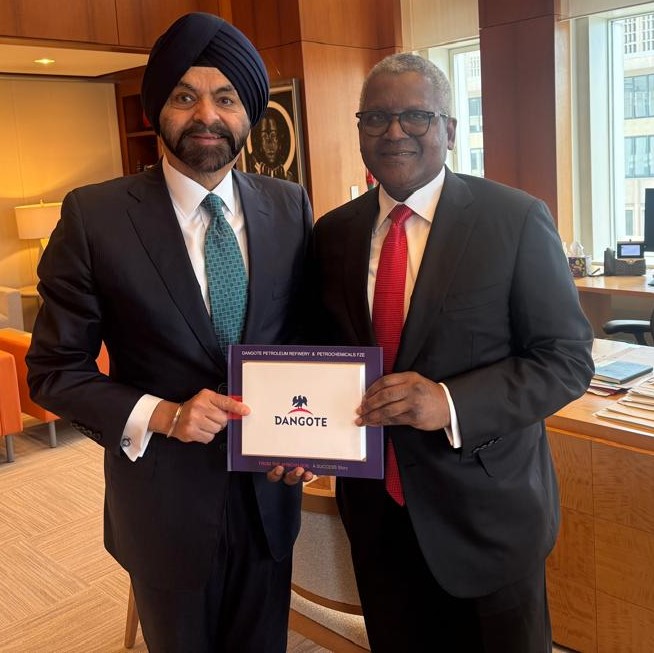
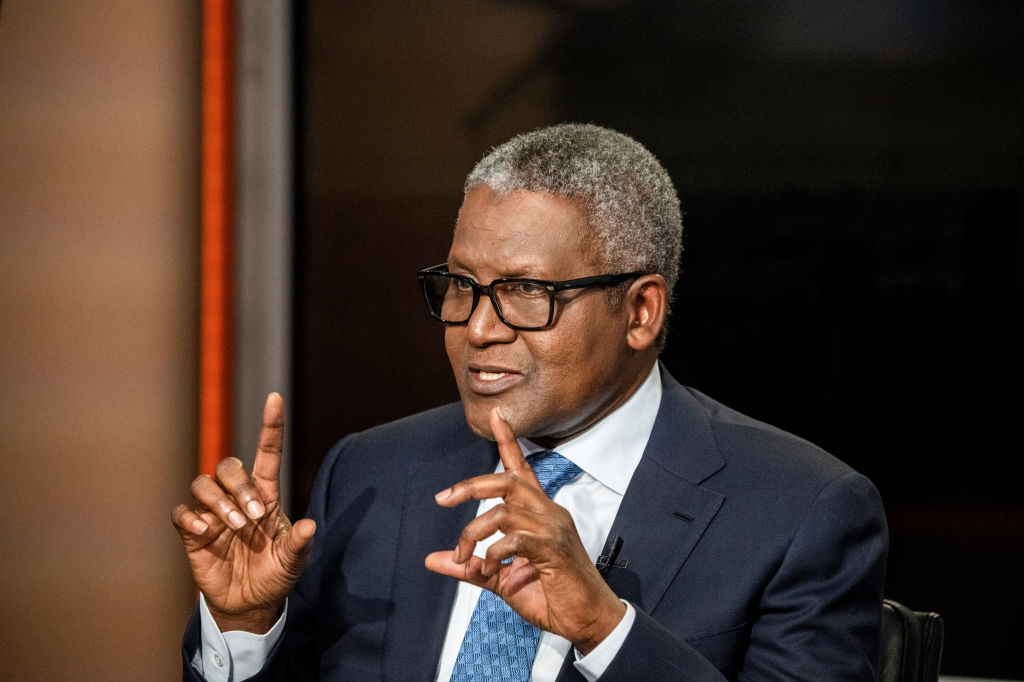
The President/Chief Executive of Dangote Industries Limited, Aliko Dangote (right) presenting a souvenir to the President of World Bank Group, Ajay Banga during a meeting at the side of the IMF/WBG Spring Meetings in Washington DC, USA





Leading investment research firm Renaissance Capital Africa (RCA) has upgraded its valuation of Dangote Petroleum Refinery and Petrochemicals (DPRP) to N700.41 per share, implying a 33.4 percent upside from the refinery’s IPO offer price of N525 per share.
According to RCA, the valuation increase reflects the refinery’s exceptional earnings performance in the first nine months of 2026, driven by stronger refining margins and better-than-anticipated operational results. Revenue, EBITDA and net profit all exceeded the firm’s expectations during the period.
READ ALSO: Dangote Refinery IPO Elicits Participation in 90 Countries Globally
In its October 16, 2026, update, titled “Stronger Refining Margins Drive Earnings Outperformance,” the investment firm cited robust refining margins and stronger operating results as key drivers of the enhanced valuation.
The remarkable investor interest comes against the backdrop of the refinery’s strong operational and financial performance. For the nine months ended September 30, 2026, the DPRP reported revenue of US22.5 billion and net profit of US4.7 billion, representing one of the strongest financial performances recorded by an African industrial enterprise in recent years.
The results marked a significant turnaround from the corresponding period in 2025, when the company recorded a loss of US117.2 million. Revenue grew by 144 percent from US9.2 billion, while EBITDA increased nearly nine-fold to US5.5billionfromUS627.6 million. Operating cash flow rose more than ten-fold to US$3.68 billion, underscoring the refinery’s growing ability to generate substantial earnings and cash flow from its operations.
The company also strengthened its balance sheet considerably, moving from a net debt position of US1.73 billion as of September 2025 to a net cash position of US651 million by September 2026, reflecting improved liquidity and financial resilience.
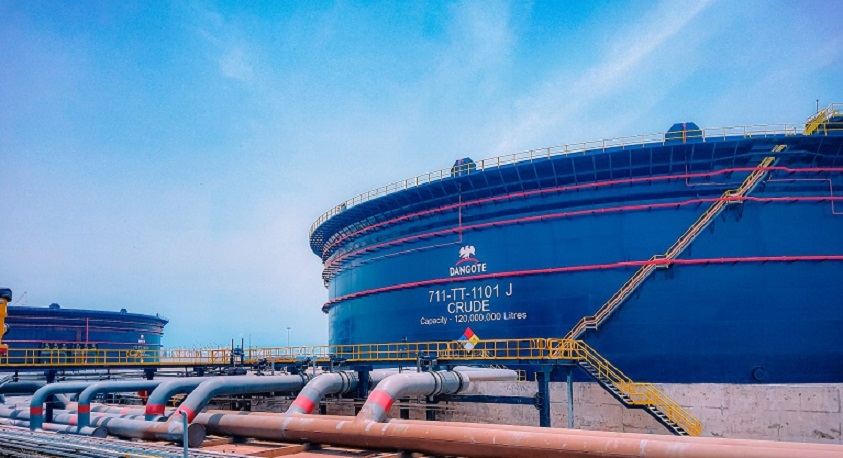
The Dangote Petroleum Refinery & Petrochemicals (DPDP) has revealed that its ongoing Initial Public Offering (IPO) has attracted exceptional participation from investors across Africa and around the world, with subscriptions received from more than 90 countries, including investors from 51 of Africa’s 54 nations.
The unprecedented level of participation positions the transaction as Africa’s first truly pan-African public offering, reflecting strong investor confidence in African-led industrialization and a growing desire among Africans to own strategic assets built on the continent.
The company noted that the IPO has already set new benchmarks in the capital markets, breaking the Nigerian market record on its opening day and surpassing the previous African record within its first ten days, driven by robust demand from retail investors, pension funds, institutional investors, asset managers, and members of the investing public.
On the milestone, Chief Financial Officer of Dangote Group, Murat Erden, said: “This offering represents far more than a capital-raising exercise. It is a landmark opportunity for Africans and global investors alike to participate in the ownership of one of the continent’s most transformative industrial assets. The extraordinary participation from individuals and institutions across Africa demonstrates a shared conviction that Africans should not only benefit from industrial development but also own and create wealth from it.”
The remarkable investor interest comes against the backdrop of the refinery’s strong operational and financial performance. For the nine months ended September 30, 2026, the DPRP reported revenue of US22.5billion and net profit of US4.7 billion, representing one of the strongest financial performances recorded by an African industrial enterprise in recent years.
READ ALSO: Makinde Fires Back at Presidency, Insists on ₦9tn NLNG Dividend Shortfall
The results marked a significant turnaround from the corresponding period in 2025, when the company recorded a loss of US117.2 million. Revenue grew by 144 percent from US9.2 billion, while EBITDA increased nearly nine-fold to US5.5 billion from US627.6 million. Operating cash flow rose more than ten-fold to US$3.68 billion, underscoring the refinery’s growing ability to generate substantial earnings and cash flow from its operations.
The company also strengthened its balance sheet considerably, moving from a net debt position of US1.73 billion as of September 2025 to a net cash position of US651 million by September 2026, reflecting improved liquidity and financial resilience.
According to Erden, the refinery’s current performance significantly exceeds the assumptions underpinning the IPO valuation. “Our financial performance has already advanced well beyond the baseline assumptions used in determining the IPO valuation. The refinery’s operational momentum, scale and efficiency continue to create substantial shareholder value and reinforce our confidence in its long-term growth prospects.”
In a major boost to African capital-market integration, the transaction has also benefited from pioneering cross-border market collaborations involving Botswana, Egypt, Ethiopia and Kenya, helping to broaden access and reduce barriers to participation for investors across the continent.
The DPDP described the IPO as a powerful demonstration of the increasing sophistication, depth and interconnectedness of African financial markets, providing a blueprint for future continent-wide investment offerings.
The company reiterated that the IPO provides a unique opportunity for investors to become shareholders in one of Africa’s largest and fastest-growing industrial enterprises, with the potential for USD-linked dividends, subject to the company’s dividend policy and applicable regulatory approvals.
With the offer scheduled to close on 27 October 2026, the company has intensified investor education and engagement activities across key markets to ensure broader inclusion and participation. The refinery emphasized that no further extension of the offer period is currently planned.
On the significance of the transaction, Erden added: “We are witnessing the emergence of a new chapter in African industrial ownership and capital-market development. The overwhelming response from investors across 51 African countries and more than 90 countries globally is a resounding vote of confidence in Africa’s future and in the ability of world-class African enterprises to deliver sustainable value for shareholders.”
The company expressed appreciation to regulators, stockbrokers, issuing houses, financial institutions, fintech partners, community leaders, investor associations and the investing public for their support and participation throughout the offer period.
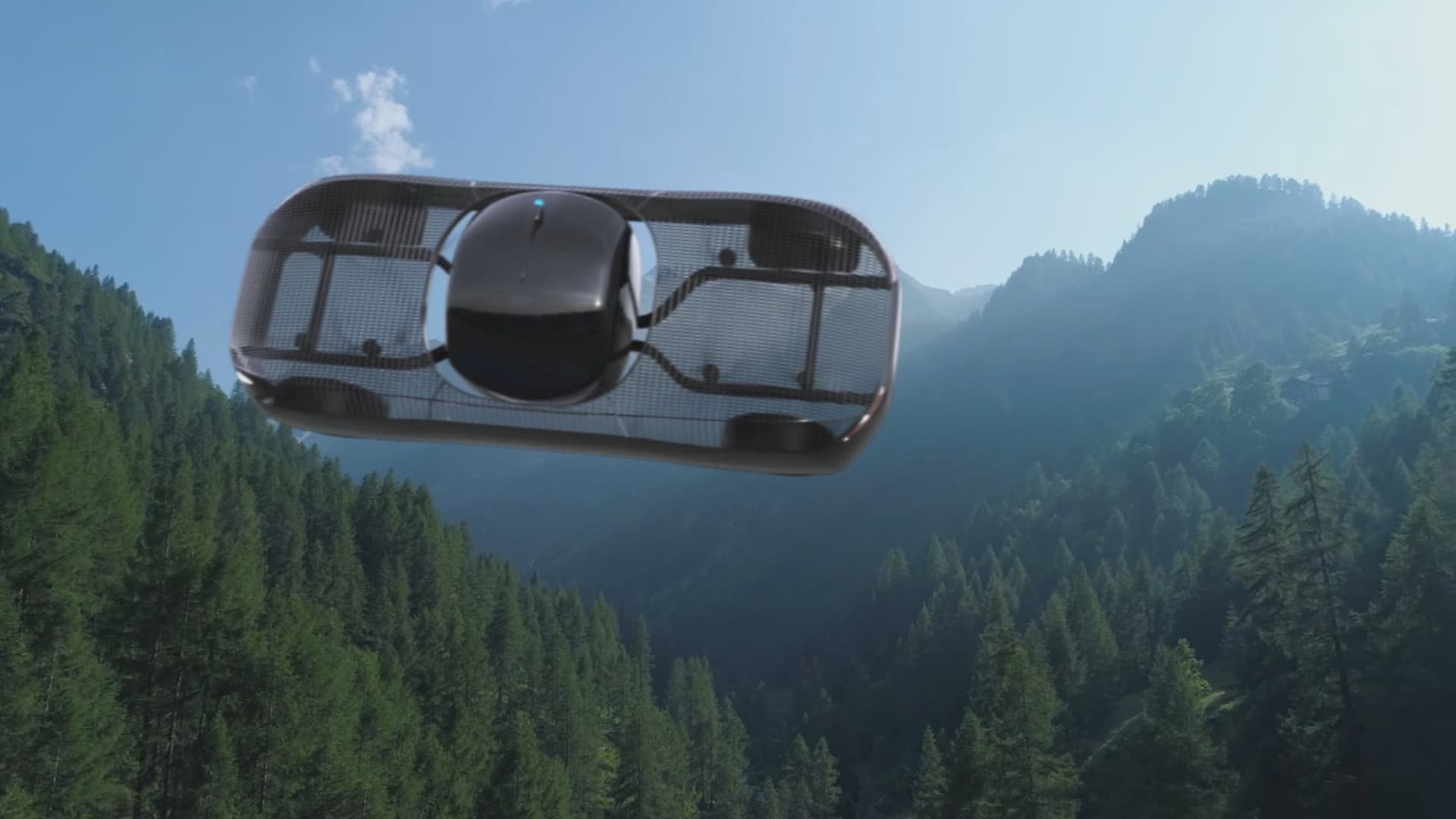
Tesla has set a 2028 commercial production date for its new Roadster sports car that can briefly rise into the air using rocket technology.
According to CNN, the date was revealed when the manufacturers demonstrated its functionality on Thursday at a SpaceX testing facility in Texas, United States, where the two-seater vehicle performed a series of manoeuvres, including driving upside down before making a short airborne movement.
The prototype was operated without a driver during the test, with Musk saying the decision was taken “to make sure we don’t kill anyone.”
“Success is not guaranteed. I mean that. It’ll probably work, but if it doesn’t work, we’re at a safe distance,” he said.
READ ALSO: 2027 Election: ‘Your Future Is More Valuable’ — IGP Warn Youths Against Political Violence
CNN reported that the vehicle uses 10 nozzles and high-pressure air tanks to generate thrust, with Musk claiming it could accelerate from zero to 60 miles per hour in less than a second.
The Tesla boss attributed the development to cooperation between the electric vehicle manufacturer and SpaceX, the rocket company he also leads.
He described the project as “the results of what happens when you have a collaboration with the world’s best car company and the world’s best rocket company.”
Musk also sought to assure spectators that the demonstration was genuine, saying, “We need an audience to prove that it’s not AI or SI. So you guys can tell people you saw it with your eyes, because what you see with your eyes, you will not believe.”
Despite the display, questions remain about whether the vehicle can achieve sustained flight and how practical it would be for everyday transportation.
Roger Conner, curator for vertical flight at the Smithsonian’s National Air and Space Museum, told CNN that combining the requirements of road vehicles and aircraft presented significant engineering challenges.
“Aircraft are extremely sensitive to weight, whereas with ground vehicles you want them to have bumpers and crumple zones and all that,” he said.
“Inevitably, something that is a hybrid between the two is going to be a poor performing aircraft and a poor performing vehicle, and also quite expensive,” he added.
Conner questioned whether the demonstration amounted to flying in the conventional sense.
“We’re not talking about sustained flight. We are literally talking about hopping,” he said.
However, Jim Dukhovny, chief executive of flying car startup Alef, said the technology was achievable, while pointing to the difficulties involved in making such vehicles transition safely from vertical take-off to forward flight.
“It absolutely is 100% feasible,” he told CNN.
“That being said, the hardest part on all eVTOLs, and for us, it’s a transition from (rising) vertical to (moving) forward. It needs to be extremely careful, making sure you do not lose lift, and making sure it’s very stable,” he added.
CNN also reported that Alef’s prototype weighs about 254 pounds, uses eight propellers and is designed to carry one person.
Musk said Tesla intended to begin production of the new Roadster in 2028.
CNN reported that the latest display adds to Musk’s ambitions to push Tesla’s vehicle technology beyond conventional electric cars, although the prototype’s ability to operate as a practical flying vehicle has yet to be established.





APC Campaign Council Sets Inaugural Meeting for Tuesday Ahead of Kaduna Flag-Off

Renaissance Capital Sees Significant Upside in Dangote Refinery, Lifts Valuation by 33.4%

Dangote Refinery IPO Elicits Participation in 90 Countries Globally

Makinde Fires Back at Presidency, Insists on ₦9tn NLNG Dividend Shortfall

‘NELFUND Is Not an Excuse for School Fees Hikes’ – NANS Warns Universities

NANS Threatens to Shut Down AE-FUNAI Over School Fees Hike

Trump’s Family Unveils New Cryptocurrency Platform

Senate Denies Receiving Petitions Against Tinubu’s Ambassadorial Nominees

Dangote Cement Lights Up Benue Host Communities With CSR Initiatives

Reps Recommend 3-year Jail Term For Aviation minister

Tems Sets New Record On Billboard Hot 100 Chart
