
NEWS
ADC Accuses Tinubu of Cooking Excuses to Snuff Out Opposition

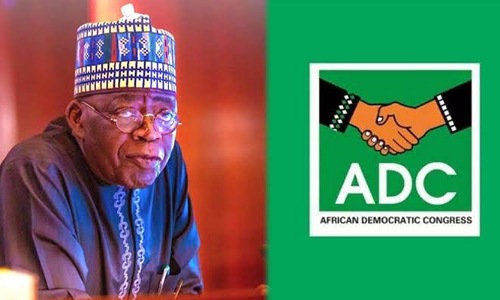
The Nigerian Government is cloaking its strategy to snuff out opposition with national security.
The African Democratic Congress (ADC) levelled the allegation a strongly worded statement on Wednesday, in which it fingered recent claims by a presidential aide.
The party averred that it had no intention of undermining democracy but is solely focused on rescuing Nigeria from what it described as the “irredeemable incompetence” of the President Bola Tinubu’s administration.
The party’s interim National Publicity Secretary, Bolaji Abdullahi, expressed concern over the APC’s growing hostility toward dissenting voices, questioning the ruling party’s apparent discomfort with opposition politics.
His remarks followed a statement on microblogging site, X by President Tinubu’s Special Adviser on Information and Strategy, Bayo Onanuga.
ALSO READ: Faulty Meters, Billing Errors Drive Electricity Complaints to 254,000
Onanuga had alleged that certain political figures were “banding together to overthrow an administration that has been the most focused, most transformative in our history.”
In its response, the ADC dismissed Onanuga’s post as “irresponsible and defamatory,” warning that such rhetoric could be used as a pretext for a wider clampdown on opposition leaders and voices critical of the government.
The ADC stated, “Bayo Onanuga’s tweet is a textbook example of a political dog whistle.
“The APC-led Federal Government appears to be constructing a false narrative designed to justify a potential crackdown on dissent and to criminalise legitimate opposition activities under the guise of protecting national security.”
In reaffirming its democratic credentials, the party noted that, “The ADC is not interested in truncating democracy.
We are solely committed to saving the nation from the irredeemable incompetence of this government. And the only means available to us is the democratic means.
“We are not soldiers; we are politicians. We don’t have bullets—only ballots. When the time comes, we will present our solutions and an alternative vision of the future to the Nigerian people and leave them to make their choice.”
Abdullahi also accused the APC of forgetting its own roots as a former opposition party, adding, “It is a great wonder that the same party, which came to power as an opposition force, now appears to find the idea of opposition unacceptable.”
The ADC therefore called on President Tinubu to rein in his aides, particularly those making what it described as “baseless but dangerous allegations that risk heating up the polity two years before the next general election.”
“This manner of crying wolf where there is none does not make the president look good and only betrays a sense of panic,” the party added.
Urging citizens to remain alert, the ADC warned of covert attempts to delegitimise the opposition and shrink democratic space.
“The health of our democracy depends on a free, open, and competitive political environment,” it noted.
The party also appealed to the international community, including democratic governments, human rights organisations, and election observers, to closely monitor the political climate in Nigeria.
“We call on them to hold the Tinubu administration accountable for any actions that undermine democratic freedoms or violate the political rights of Nigerian citizens.
“The ADC remains committed to building a better Nigeria—through peace, participation, and the power of the people,” he said.







The Federal Government and state governments have stepped up efforts to tackle child malnutrition and stunting, with a renewed commitment to take nutrition interventions to communities and households across Nigeria’s 774 local government areas.
The initiative, known as Nutrition 774, is designed to strengthen grassroots action through coordinated interventions in healthcare, education, agriculture, water supply, sanitation and social protection.
The development was disclosed by Stanley Nkwocha, Senior Special Assistant to the President on Media and Communications in the Office of the Vice President, in a statement released on Friday, October 9, 2026.
SEE ALSO: FG Reveals Six Locations for Proposed 24-Hour Power Supply Zones
The statement followed the Nigeria–Ethiopia Nutrition Leadership Exchange in Addis Ababa, Ethiopia, where Nigerian officials are studying strategies adopted by the East African country to improve nutrition outcomes.
The Nigerian delegation is led by Vice President Kashim Shettima, with state governors and federal ministers participating in discussions on how to translate nutrition policies into measurable improvements in the lives of Nigerians.
Nigeria, Ethiopia to Develop Nutrition Roadmap
The Coordinating Minister of Health and Social Welfare, Professor Muhammad Ali Pate, said Nigeria and Ethiopia would develop a roadmap based on lessons from the leadership exchange to accelerate progress in tackling malnutrition.
Pate described nutrition as a critical component of human capital development, stressing that addressing the challenge required cooperation across government institutions and society.
“Nutrition is key to human capital development, and it requires sectors to work together in a whole-of-government and whole-of-society approach,” he said.
The minister acknowledged progress made through national interventions and community-based programmes but called for stronger implementation.
“We have to now go back and deepen the progress, accelerate,” Pate added.
He expressed optimism that sustained efforts over the next four to five years could produce significant results, particularly for children.
“There are reasons to be optimistic that if we continue in this direction over the next four to five years, Nigeria will achieve remarkable success in dealing with key issues affecting the people of Nigeria, particularly the children who are the future of our country,” he said.
Adeleke, Otti Highlight Need for Better Nutrition Policies
Osun State Governor Ademola Adeleke said nutrition interventions should prioritise children under five and pregnant women, noting that Nigeria needed to build on the progress already recorded.
“Especially for the young ones under five and, of course, pregnant women, it is very, very important,” Adeleke said.
He added that learning from Ethiopia’s experience could help Nigeria improve its approach.
“We have some success, but we can improve on it. That is why I am here, to learn from our counterparts in Ethiopia,” the governor said.
Abia State Governor Alex Otti also urged Nigerian authorities to learn from countries that had made progress in addressing nutrition challenges.
“There’s nothing wrong with saying that we have not done as well. And there’s also nothing wrong in learning from those who have done it, so that you don’t go reinventing the wheel,” Otti said.
He explained that malnutrition could not be addressed through food security alone, as healthcare, education, agriculture, climate change and poverty reduction were closely connected.
“Today, we have learned that it’s not just about food security. It’s also about health. It’s about education. It’s about climate change. It’s about agriculture. So, a whole lot of things are intertwined,” he said.
The governor also highlighted Abia’s investment in education, including the recruitment of 9,469 teachers, the development of 20 smart schools and the rehabilitation of more than 200 primary and secondary schools.
He said the state was committing approximately 20 per cent of its annual budget to education.
Insecurity Complicates Nutrition Efforts in Zamfara
Zamfara State Governor Dauda Lawal said insecurity had made it more difficult for the state to address nutrition challenges, despite its history of substantial food production.
“In the past, when you spoke about nutrition, we didn’t even have anything like that in the state because we produced enough to feed our people. However, because of those challenges now, it has become difficult,” Lawal said.
He, however, insisted that insecurity should not prevent the state from pursuing development initiatives.
“Should we be defined by the insecurity? The question is no. What else can we do?” he asked.
Lawal said Zamfara would continue to align with Federal Government programmes while adapting interventions to the specific needs of its communities.
Jigawa Trains 600 Women in Child Nutrition Programme
Jigawa State Governor Umar Namadi said Ethiopia’s experience under the Seqota Declaration offered useful lessons for Nigeria’s Nutrition 774 Initiative.
He stressed that the programme must extend beyond national and state institutions to reach local governments, wards, communities and individual households.
“The one thing that is very important with 774 is the fact that it will have to go down from the national level to each local government, each ward, each community and each household,” Namadi said.
The governor also highlighted Jigawa’s homegrown nutrition programmes, including the Masaki initiative and a Tom Brown programme designed to promote nutritious food for children.
According to Namadi, approximately 600 women had been trained to produce nutritious food for children under the Tom Brown programme.
The initiative reflects the role state governments can play in complementing federal policies with community-based interventions.
Education Minister Warns of Consequences of Poor Early Nutrition
The Minister of Education, Dr Maruf Tunji Alausa, said efforts to tackle malnutrition must begin during pregnancy and continue through the critical early years of a child’s development.
He warned that inadequate nutrition during this period could have lasting consequences for children’s future.
“If we miss that period, the 2,000 days, we’ve set those children up for failure in life,” Alausa said.
The minister explained that the Nutrition 774 agenda was designed to move nutrition interventions from the Federal Government to state governments, local authorities and communities.
“We have an expansive 774 nutrition agenda that drives our nutrition agenda from the federal to the subnational government, state, local government and the community,” he said.
FG Links Nutrition to Water Supply, Sanitation
The Minister of Water Resources and Sanitation, Professor Joseph Utsev, said improved nutrition depended on reliable water supply, sanitation, agricultural production and healthy living conditions.
“When we talk about the workforce, we must first talk about healthy living. A human being must be healthy before he can impact positively in any role given to him,” Utsev said.
He stressed that water was essential not only for drinking and sanitation but also for irrigation and food production, making it an important part of Nigeria’s broader nutrition strategy.
The Federal Government’s renewed commitment places state and local governments at the centre of efforts to improve nutrition outcomes.

The Minister of Finance and Coordinating Minister of the Economy, Taiwo Oyedele, has said the petrol discount introduced by NNPC Retail Limited could strengthen the company’s business and potentially increase profits and dividends to the Federation, despite the reduction in its retail margin.
Oyedele explained that the discount, which took effect on October 1, 2026, was a commercial decision by NNPC Retail to lower petrol prices for consumers without relying on public funds.
The minister stated this in a press release issued by the Federal Ministry of Finance on Friday, October 9, 2026, while addressing concerns that the price reduction represented a return of fuel subsidy.
According to him, the company could offset the reduction in its earnings per litre by selling more petrol over time and retaining customers beyond the discount period.
SEE ALSO: NNPC Ltd Anchors Meeting Crude Production Target on Sustained Drilling
“A smaller margin or temporary zero margin on each litre can be more than offset by selling more litres over time,” Oyedele said.
He added that the discount could strengthen customer loyalty, potentially increasing NNPC Retail’s profitability and the dividends paid to the Federation.
Why NNPC Is Cutting Its Retail Margin
Oyedele explained that the petrol discount was different from the fuel subsidy regime abolished by the Tinubu administration in 2023.
He said a margin discount occurs when a retailer voluntarily reduces its profit margin and passes the savings to consumers, with the retailer bearing the cost.
A fuel subsidy, by contrast, involves the government paying part of the price consumers would otherwise pay, using public revenue.
“The cost of the discount is borne by the retailer alone,” the minister said.
He maintained that the NNPC Retail discount was not being financed through the federal budget or the Federation Account.
According to him, NNPC Retail purchases petrol from the Dangote Refinery and other suppliers at market prices on commercial terms before adding its retail margin to determine pump prices.
The discount, he explained, comes from that margin, allowing the company to reduce prices while keeping them market-reflective.
NNPC Discount Could Benefit Consumers and Government
The minister said NNPC Retail Limited, a wholly owned subsidiary of NNPC Limited, was established more than 20 years ago to support the availability, distribution and affordability of refined petroleum products across Nigeria.
He noted that the company’s responsibilities extended beyond maximising retail profits to ensuring that petroleum products remained accessible to consumers nationwide.
According to Oyedele, NNPC Retail has historically sold petrol at prices below those of other marketers, with the current discount continuing that role.
He argued that lower margins do not necessarily translate into lower overall profits, as increased sales volumes could compensate for reduced earnings on individual litres.
The minister also said improved customer retention could support the company’s business beyond the discount period.
However, he did not provide projected sales figures or financial estimates showing how much additional profit or dividend revenue the company could generate.
Minister Dismisses Concerns Over Federal Revenue
Oyedele also addressed concerns that reducing NNPC Retail’s margin could affect the profits of NNPC Limited and reduce dividends paid to the Federation.
He said the outcome would depend on the company’s ability to increase sales and offset the lower margin through higher volumes.
The minister maintained that the commercial arrangement could benefit both consumers and government if the company succeeded in expanding sales while maintaining profitability.
He described margin discounts as a routine commercial strategy used by retailers internationally.
Oyedele Rules Out Market Distortion and Smuggling Concerns
The finance minister further argued that the discount would not significantly distort the domestic petrol market or create new incentives for cross-border smuggling.
He said the retail margin on petrol accounted for less than five per cent of the pump price, limiting the extent to which a discount could widen the price gap between Nigeria and neighbouring countries.
According to him, petrol prices in neighbouring countries were already 20 to 40 per cent higher than in Nigeria.
He therefore maintained that reducing the retail margin would not create the kind of market distortions associated with previous fuel subsidy arrangements.
Government Lists Other Measures to Reduce Fuel Costs
Acknowledging the pressure of fuel prices on households and businesses, Oyedele said the discount was one of several measures being pursued by the government to ease the burden on Nigerians.
He listed the expansion of compressed natural gas transport, the waiver of taxes and duties on petrol, and the removal of illegal levies that increase transportation costs among the government’s interventions.
The minister said the measures were designed to provide relief without returning the country to a fuel subsidy regime that the government considers financially unsustainable.
He reiterated that the NNPC Retail discount lowers petrol prices without direct public funding and could strengthen the company’s commercial performance if increased sales offset the reduced margin.
The Federal Government on Thursday announced that the Nigerian National Petroleum Company Limited will forgo its retail profit margin on petrol and sell to Nigerians at cost, as part of measures to cushion households from global crude oil price shocks.
This was as the Presidency said the arrangement, backed by President Bola Tinubu, does not signal the return of the petrol subsidy, which ended on May 29, 2023.
The petrol price slash was among a raft of measures announced by the Minister of Finance and Coordinating Minister of the Economy, Taiwo Oyedele, on Thursday.
In a statement signed Thursday by the Special Adviser to the President on Information and Strategy, Bayo Onanuga, the Presidency said NNPC Retail, which already sells petrol at the lowest price in the market, will roll out the new deal within 30 days.
READ ALSO: NUPRC Shares Priorities for Next Phase of Growth
The statement is titled ‘NNPC retail forgoes petrol profit margin to offer some support to Nigerian households amid global petrol crisis; FG announces additional measures.’
“This means if NNPC’s landing cost is N1300, it will sell fuel to Nigerians, especially commercial vehicles, at the same price,” the statement read.
Briefing journalists on Thursday, Oyedele said the Federal Government hoped other marketers would follow NNPCL’s example, as the sharp rise in crude and petrol prices was not expected to last long.
The Presidency said the Federal Government was also negotiating a ceiling of N1,350 per litre on the ex-gantry or landing cost of petrol to keep pump prices stable.
It said where costs rise above the ceiling, refiners and importers will bear the shortfall and recover it later, when crude prices or the exchange rate allow, without breaching the ceiling.
“This is neither a subsidy nor a price control: it is designed to smooth prices over time rather than suppressing them,” Oyedele was quoted as saying, adding, “The reasoning is simple. 1,400 naira a litre today and 1,400 tomorrow is better than 1,500 today and 1,300 tomorrow, because volatility itself adds to uncertainty and cost. And when fares rise sharply, they rarely fall as fast. The ceiling will be reviewed monthly, reset as costs require, and the figures published for transparency.”
The FG, he said, will also sell crude forward to domestic refineries. According to the statement, this is expected to shield pump prices from global volatility as production rises and previously committed crude is freed up.
The statement noted that under the 2025 tax reform laws, the Federal Government, working with the states and security agencies, was reining in the collection of road taxes and levies that inflate fares and logistics costs. It is also increasing funding for cash transfers to the most vulnerable households and for subsidised credit to small businesses and consumers.
The other measures listed include the CNG rollout, where the FG is scaling up compressed natural gas deployment with the states, and expects transporters to pass on the savings to passengers through lower fares. CNG is 60 to 70 per cent cheaper than petrol, the statement said.
It said excess profit tax will be considered for operators who take undue advantage of consumers anywhere along the energy value chain.
Proceeds will be used only to cushion fuel prices through transport support or vouchers for urban minimum-wage earners. The government will also work with the National Assembly on enhanced tax relief for low-income earners under the 2027 Finance Bill.
The FG, according to Onanuga, is cutting regulatory costs that feed into the cost of doing business and, indirectly, into the prices of goods and services. The FG, he added, is investing in a reserve from which it will release refined products into the market, under published rules, whenever a global disruption or hoarding threatens supply and price stability.
The Presidency said this was “not a subsidy” and did not fix prices, but secured supply and would deter artificial scarcity and market manipulation.
It argued that traffic management agencies will improve traffic flow in major urban centres to cut fuel consumption, while NIPOST’s newly launched address codes will make logistics more efficient and cheaper.
The Presidency explained that none of the measures restored a blanket subsidy, adding that doing so “would create longer-term harm for a short-term cure.”
It said, “Removing the fuel subsidy came at a price. But the alternative has been tried. Nigeria has already lived through that cycle: scarcity, smuggling, a collapsing currency and a fiscal crisis. We cannot afford to live through it again, least of all in response to a temporary disruption, and at the very moment the results of reform are gathering pace.
“Government is not out to reverse a necessary reform designed to set our country on the path towards sustained prosperity. It is to ensure its gains reach more Nigerians, faster and in more tangible ways. That is our work, and we are committed to doing it.”
The Presidency added that the FG was working on a comprehensive package of fiscal measures to bring inflation down to single digits sustainably in the near term.






Malnutrition: FG, States Take Nutrition 774 Initiative to 774 LGAs

NNPC Petrol Discount: Oyedele Explains How Lower Margins Could Boost Profits

Presidency Explains Petrol Discount Offering

NUPRC Shares Priorities for Next Phase of Growth

Nigeria Resorting to Gas for Speedy Industrialisation — Ekpo
Adeshina Hinges Nigeria’s Energy Growth on Technical Expertise, Quality Investment

Trump’s Family Unveils New Cryptocurrency Platform

Senate Denies Receiving Petitions Against Tinubu’s Ambassadorial Nominees

Dangote Cement Lights Up Benue Host Communities With CSR Initiatives

Reps Recommend 3-year Jail Term For Aviation minister

Tems Sets New Record On Billboard Hot 100 Chart

jstbuu